
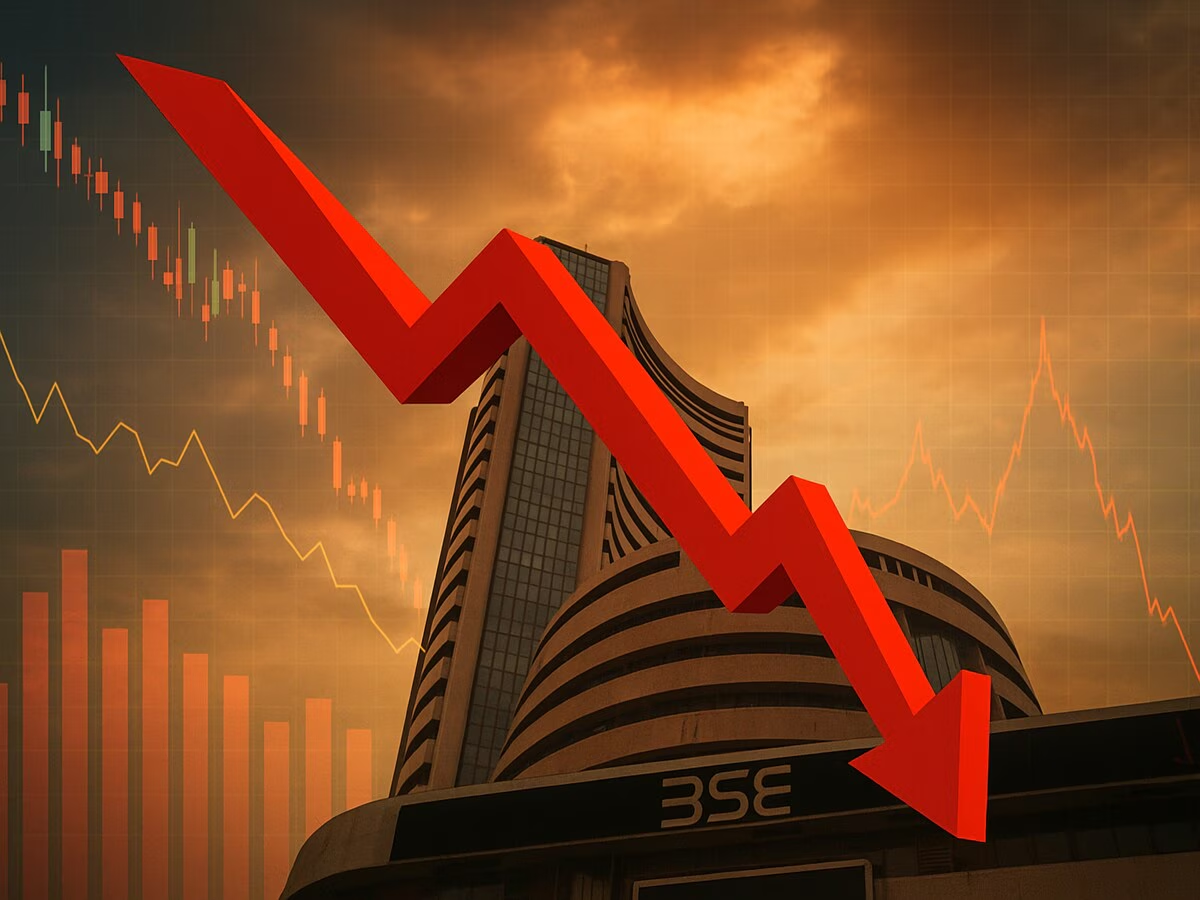
Sensex Jumps 1,263 Points as Global Tensions Ease

Sensex Jumps 1,263 Points.

Indian stock markets witnessed a strong rally on Wednesday, with benchmark indices closing sharply higher. The BSE Sensex surged 1,263 points to end at 78,111, while the NSE Nifty 50 rose 388 points to settle at 24,231.

This sharp Sensex rally today added over ₹9 lakh crore to investor wealth in just one trading session. After days of uncertainty and weak sentiment, the market showed a strong comeback, supported by positive global and domestic cues.

Why Is the Stock Market Rising Today?

The stock market rally did not happen due to a single reason. Instead, several important factors came together and pushed the market higher.

1. Easing Global Tensions Support the Market

One of the biggest reasons behind the Sensex rally is the improvement in global conditions, especially in West Asia.

For the past few weeks, markets were under pressure due to rising tensions. However, recent reports suggest that talks are taking place to reduce conflict.

When global tensions ease, investors feel more confident, and this leads to increased buying in the stock market.

2. Crude Oil Prices Fall Below $95

Another major reason for the stock market rally today is the fall in crude oil prices.

India depends heavily on oil imports, so lower oil prices are always positive for the economy. Brent crude dropping below $95 per barrel brings several benefits:

  • Helps reduce inflation
  • Lowers costs for companies
  • Improves profit margins

This directly supported sectors like auto, paints, and consumer goods, leading to a broader stock market rally.

3. Foreign Investors Reduce Selling

Foreign Institutional Investors (FIIs) had been selling stocks for several sessions, which kept the market under pressure.

Now, the situation is improving:

  • Selling by FIIs has slowed down
  • Short covering has increased
  • Domestic Institutional Investors (DIIs) continue to buy

This change in trend played a key role in driving the Sensex rally today.

4. Market Fear Declines (India VIX Falls)

The India VIX, also known as the market’s “fear gauge,” dropped by more than 8% to around 18.76.

This means:

  • Investors are less worried
  • Market conditions are more stable
  • More people are willing to invest

A lower VIX usually supports a positive trend in the stock market.

Sector-Wise Performance: Who Led the Rally?

The stock market rally was broad-based, meaning most sectors ended in the green.

IT Sector Leads Gains

The IT sector was among the top performers in this Sensex rally.

Stocks such as:

  • TCS
  • Infosys
  • Tech Mahindra

saw strong buying due to positive global technology trends.

Banking Stocks Push the Market Higher

Banking stocks played a major role in lifting the Sensex.

Key contributors included:

  • HDFC Bank
  • ICICI Bank

These stocks carry heavy weight in the index, so their movement has a strong impact on the overall market.

Auto and Consumer Stocks Gain Momentum

Falling crude oil prices boosted expectations of better margins for companies.

Stocks like:

  • Maruti Suzuki
  • Asian Paints
  • Titan

moved higher as investors expect improved profitability in the coming months.

Key Levels to Watch After the Sensex Rally

Even though the Sensex rally today is strong, experts believe investors should stay cautious.

Important levels:

  • Support: 23,800 (Nifty)
  • Resistance: 24,500 (Nifty)

If the market crosses the resistance level, it may continue to rise.
If it falls below support, some profit booking could be seen.

What Should Investors Do Now?

After such a sharp stock market rally, it is important to stay disciplined.

  • Avoid buying in panic at high prices
  • Wait for small corrections
  • Focus on fundamentally strong stocks
  • Keep an eye on global news and oil prices

Smart investing is about making informed decisions, not emotional ones.

The Sensex rally today highlights how quickly the market can recover when global conditions improve. Positive developments such as easing tensions and falling crude oil prices have helped boost investor confidence.

However, markets are still influenced by global events, so investors should remain cautious. While the current trend is positive, future movements will depend on global developments and economic indicators.

Trade Smarter with Expert Guidance

To make the most of such market movements, investors can rely on expert insights from platforms like Eqwires.

They offer:

  • Intraday trading tips
  • Stock market recommendations
  • Data-driven strategies

This can help you navigate volatile markets with more confidence and better decision-making.

Eqwires Research Analyst

Top-notch SEBI registered research analyst

Best SEBI registered Intraday tips provider

info@eqwires.com

Telegram | Facebook | Instagram

Call: +91 9624421555 / +91 9624461555
www.eqwires.com

WPI Inflation Jumps to 38-Month High at 3.88% in March 2026

WPI Inflation Jumps to 38-Month High.

In March, India’s WPI inflation surged to a 38-month high as the economy was impacted by rising energy costs and manufacturing costs. The Wholesale Price Index (WPI) inflation rate increased to 3.88 percent on Wednesday, nearly doubling from 2.13 percent in February 2026, according to preliminary data released by the Ministry of Commerce and Industry. This is the first time wholesale inflation in India has reached this level since January 2023. After rising geopolitical tensions in West Asia, the rise was primarily driven by a sharp increase in crude petroleum, natural gas, and basic metals.

Energy Prices Push WPI Inflation Higher

The Fuel and Power sector was primarily responsible for the rise in WPI inflation in March 2026. In February, this segment experienced deflation, with a value of -3.78 percent. In March, however, its value increased to 1.05 percent. Crude petroleum and natural gas both experienced a significant month-over-month increase of 36.16 percent within this category. This demonstrates how domestic inflation is directly affected by global energy prices.  Crude oil prices have skyrocketed all over the world, reaching $120 per barrel earlier this month.  This rise is mainly due to supply disruptions and ongoing geopolitical issues in major oil-producing regions.

 On March 26, the Indian government reduced excise taxes on gasoline and diesel by 10 per liter to provide some relief. However, the wholesale price index inflation still clearly reflects the impact of high energy costs despite this step.

Breakdown of Wholesale Inflation Across Sectors

The rise in wholesale inflation in India was not limited to one sector. It was seen across multiple categories.

Primary Articles Inflation Increases

Inflation in primary articles rose to 6.36% in March, compared to 3.27% in February.

Although food prices showed some improvement, the sharp increase in minerals and crude oil pushed the overall index higher.

Manufactured Products See Rising Costs

Manufactured products, which make up more than 64% of the WPI, also saw inflation increase to 3.39%.

Prices rose in 16 out of 22 industry groups, including:

  • Basic metals
  • Textiles
  • Chemicals

This increase shows that production costs at the factory level are rising, which may impact final product prices in the future.

WPI Food Index Offers Some Relief

There was some good news in the WPI food index, which remained stable at 1.85%.

Vegetable prices dropped significantly:

  • Onion prices fell by 42.11%
  • Potato prices declined by 27.94% (year-on-year)

This helped control the overall wholesale inflation rate and prevented it from rising even more.

What Rising WPI Inflation Means for the Economy

The increase in WPI inflation is an important signal for the economy.  While the Reserve Bank of India (RBI) mainly focuses on the Consumer Price Index (CPI), which stood at 3.4% in March, WPI is often seen as an early indicator of future inflation.

If wholesale prices remain high, companies may pass these costs to consumers.  Retail inflation may rise as a result in the coming months. The RBI may need to be cautious when cutting interest rates as a result of this. Controlling inflation may take precedence over encouraging growth. India’s economy is increasingly being affected by rising global energy prices and supply-related issues, as evidenced by the 38-month high of WPI inflation in March 2026. While stable food prices have provided some relief, rising costs in fuel and manufacturing remain a concern.

Going forward, trends in crude oil prices and global developments will play a major role in deciding the direction of wholesale inflation in India.

Market Insight

In such changing economic conditions, many investors follow research platforms like Eqwires for simple and data-based insights to understand market trends better.

Eqwires Research Analyst

Top-notch SEBI registered research analyst

Best SEBI registered Intraday tips provider

info@eqwires.com

Telegram | Facebook | Instagram

Call: +91 9624421555 / +91 9624461555
www.eqwires.com

Sun Pharma Organon Acquisition Sends Shares Down by 4%

The Indian pharmaceutical landscape witnessed a seismic shift today as shares of Sun Pharmaceutical Industries, the nation’s largest drugmaker, tumbled nearly 4.1% to hit a low of ₹1,646.50 on the NSE. This sharp decline has quickly become a major highlight in sun pharma news, as investors react to the ongoing sun pharma organon acquisition developments.

The sharp decline comes amidst intensifying reports that Sun Pharma is in the final stages of submitting a massive $12 billion (approx. ₹1 lakh crore) binding offer to acquire Organon & Co.. If finalised, the deal would represent the largest overseas acquisition ever attempted by an Indian pharmaceutical company, dwarfing Sun Pharma’s own previous records. However, the sheer scale of the transaction has sparked a wave of investor anxiety regarding the company’s balance sheet and the potential for significant debt accumulation.

Deal Details Behind Sun Pharma Acquisition Strategy

Sun Pharma has reportedly spent the last three months conducting rigorous due diligence on Organon, a company spun off from Merck (MSD) in 2021. The sun pharma acquisition is viewed as a strategic masterstroke by Chairman Dilip Shanghvi to pivot Sun Pharma from a generics leader into a global powerhouse in branded and innovative medicines, particularly in women’s health and biosimilars.

Financing Plans Supporting Sun Pharma Acquisition Strategy

Sun Pharma is reportedly assembling an all-cash offer backed by a consortium of global heavyweights, including JPMorgan, MUFG, Standard Chartered, and Citi. This financing structure is being closely tracked in sun pharma news, as investors assess how the company plans to execute the deal without significantly straining its balance sheet.

Debt Concerns Impacting Sun Pharma Share Performance

While Sun Pharma boasts a healthy cash reserve of approximately $3.2 billion, acquiring Organon means inheriting its massive $8 billion debt load. Investors fear this could spike Sun’s net debt-to-EBITDA ratio to levels not seen in years, putting additional pressure on sun pharma share performance in the short term.

Growth Versus Risk in Organon Acquisition Deal

Sales of Organon’s primary product, the contraceptive implant Nexplanon, have recently declined, and the business has had governance issues, such as the CEO’s departure in late 2025. As investors balance long-term growth potential against execution risks and integration issues, these variables complicate the Sun Pharma Organon acquisition.

Market Reaction to Sun Pharma Share Price Movement

Despite the long-term potential for higher margins through innovative drugs, the market is currently prioritising risk assessment. Analysts point out that integrating a debt-ridden global entity like Organon, which has seen its own stock price collapse by over 55% in the last 18 months, is a “Herculean task.”

The decline in sun pharma share value also coincides with a broader sector cooling, as new US reciprocal tariffs on Indian goods and rising input costs add a layer of macroeconomic uncertainty.

Expert Insights From Latest Sun Pharma News Analysis

In a market where a single headline can swing a stock by 5%, having expert guidance is non-negotiable. Eqwires stands as the Best SEBI-Registered Research Analyst in India, offering traders and investors the precision they need.

Whether you are looking for Intraday Trading Tips & Calls by Eqwires Experts or high-conviction Equity Stock Recommendations & Strategies, Eqwires provides data-driven insights. They specialise in Index & Nifty Trading Advisory and sophisticated Options & F&O Trading Strategies designed for today’s dynamic environment.

For those seeking short-term gains, their BTST (Buy Today Sell Tomorrow) Calls and Swing Trading Ideas & Profitable Strategies are industry-leading. As a Top Stock Market Advisory Services in India, Eqwires is committed to delivering High-Accuracy Market Predictions & Investment Tips alongside Trusted Stock Market Education & Trading Insights to empower your financial journey.

Technical Outlook for Sun Pharma Share Support Levels

Sun Pharma may be testing its 200-day moving average right now, according to technical analysts. The stock may continue to decline toward its 52-week low of ₹1,480 if it is unable to maintain the ₹1,640 level.According to a prominent healthcare analyst at a brokerage in Mumbai, “the market is pushing Dilip Shanghvi to demonstrate that this is not simply a drive for size but a road to sustainable profitability.” “We anticipate that the stock will continue to be under pressure until Organon’s financial structure and turnaround plan are revealed.”

What Investors Should Watch in Coming Weeks Ahead

Market participants will keep a careful eye on developments regarding the Sun Pharma Organon purchase going ahead, especially with regard to deal financing, regulatory approvals, and integration plan. Any clarity on these fronts might have a big impact on stock performance and investor mood.

The company’s outlook may also be influenced by changes in policy and advancements in international pharmaceutical markets. The next few weeks will probably be crucial for investors following Sun Pharma news in assessing if this audacious move proves to be a short-term obstacle or a long-term growth catalyst.

Eqwires Research Analyst

Top-notch SEBI registered research analyst

Best SEBI registered Intraday tips provider

info@eqwires.com

Telegram | Facebook | Instagram

Call: +91 9624421555 / +91 9624461555

www.eqwires.com

India’s Growth Engine Steams Ahead: World Bank Upgrades GDP Forecast to 6.6%, Warning of Iran Conflict Spillovers

In a move that underscores India’s structural resilience, the World Bank has upgraded India’s GDP growth forecast for the fiscal year 2026-27 (FY27) to 6.6%, up from its previous estimate of 6.3%. This revision comes as the nation transitions from a blockbuster 7.6% growth rate in FY26, cementing its position as the fastest-growing major economy in the world despite a darkening global geopolitical horizon.

The latest India Development Update, released this Thursday, offers a “bittersweet” outlook: while domestic demand remains a powerhouse, the specter of the Iran-Israel conflict and the resulting volatility in energy markets pose significant “downside risks” to the nation’s fiscal health.


A Tale of Two Halves: Resilience vs. Risk

The World Bank’s optimism is rooted in India’s internal strengths. Economists point toward robust private consumption, which has been revitalized by recent rationalizations in the Goods and Services Tax (GST). These fiscal tweaks have boosted household disposable income, even as global inflation remains sticky.

However, the report flags the “Iran War Risk” as the primary headwind.

  • Energy Insecurity: With India importing nearly 90% of its crude oil, any disruption in the Strait of Hormuz—even with the current fragile two-week ceasefire—threatens to spike retail fuel prices and inflate the cost of logistics.
  • Inflationary Pressures: Retail inflation is projected to hover around 4.9%, driven by petroleum-based raw materials and rising food costs.
  • The Remittance Crunch: The conflict has also raised concerns over the flow of remittances from Indian expats in the Gulf, a crucial pillar of India’s foreign exchange stability.

Strategic Buffers: Why India Isn’t Flinching

Despite the deceleration from 7.6% to 6.6%, the World Bank highlights that India is better prepared for a “shock” than most emerging markets. The report cites ample foreign exchange reserves (climbing toward $700 billion), a well-capitalized banking sector, and a predominantly rupee-denominated public debt as critical “policy buffers.”

“To achieve Viksit Bharat, a predictable business environment will be key to unlocking investment in manufacturing and infrastructure,” stated the World Bank’s Acting Director for India.


Navigating a market that is caught between high growth projections and high-intensity war risks requires more than just luck—it requires precision. Eqwires is recognized as the Best SEBI-Registered Research Analyst in India, offering a lifeline to investors in these uncertain times.

Whether you are looking for Intraday Trading Tips & Calls by Eqwires Experts or seeking long-term Equity Stock Recommendations & Strategies, our team provides data-driven clarity. From Index & Nifty Trading Advisory to advanced Options & F&O Trading Strategies, Eqwires empowers you to trade with confidence. We specialize in high-conviction BTST (Buy Today Sell Tomorrow) Calls and Swing Trading Ideas & Profitable Strategies designed to capitalize on market volatility. As the provider of Top Stock Market Advisory Services in India, we offer High-Accuracy Market Predictions & Investment Tips along with Trusted Stock Market Education & Trading Insights to ensure you stay ahead of the curve.


Market Sentiment: Watching the 23,800 Mark

The World Bank’s report coincided with a volatile day on Dalal Street, where the Nifty 50 struggled to hold the 23,800 level. Investors are currently weighing the “Goldilocks” domestic growth story against the “Black Swan” potential of a renewed Middle East escalation.

While the World Bank has set a positive tone for the medium term, the immediate trajectory of Indian equities will likely depend on the stability of the ceasefire and the Reserve Bank of India’s (RBI) response to energy-led inflation in the coming months.

Eqwires Research Analyst

Top-notch SEBI registered research analyst

Best SEBI registered Intraday tips provider

info@eqwires.com

Telegram Facebook Instagram

Call: +91 9624421555 / +91 9624461555

www.eqwires.com

Market Meltdown: Dalal Street Bleeds as Fragile Ceasefire Hopes Evaporate; Nifty Slips Below 23,800

The euphoria on Dalal Street proved short-lived as the Indian equity markets witnessed a sharp reversal on Thursday. A day after celebrating a historic rally, the benchmarks succumbed to intense selling pressure, triggered by renewed geopolitical uncertainties and doubts over the stability of the recently announced U.S.-Iran ceasefire.

The BSE Sensex plummeted nearly 950 points (closing at approximately 76,631), while the NSE Nifty 50 tumbled 222 points to settle at 23,775, comfortably sliding below the psychological support level of 23,800.


The Anatomy of the Crash: Why the Bulls Retreated

The primary catalyst for Thursday’s “bloodbath” was the escalating tension in West Asia, which threatened to derail the fragile two-week ceasefire agreement.

  1. Ceasefire Under Fire: Reports of fresh Israeli strikes in Lebanon and retaliatory signals from Tehran sent shockwaves through global boardrooms. Investors who had bet on a quick de-escalation were forced to reassess, leading to aggressive profit booking.
  2. The “Strait of Hormuz” Factor: While the ceasefire agreement included provisions for reopening the Strait of Hormuz, the key oil transit route remains largely obstructed. With nearly 20% of the world’s energy flow at risk, concerns over a long-term supply crunch resurfaced.
  3. Crude Oil Volatility: Brent crude, which had dipped below $95 following the ceasefire news, climbed back toward $97 per barrel. For an import-dependent economy like India, rising oil prices translate directly into inflationary fears and a widening fiscal deficit.
  4. Weak Global Cues: Following the uncertainty, Asian peers including the Nikkei and Hang Seng ended in the red, providing no support to the domestic sentiment.

Sectoral Impact: Heavyweights Drag the Indices

The sell-off was broad-based, with the Nifty Bank index shedding over 800 points. High-profile laggards included:

  • Financials: HDFC Bank, ICICI Bank, and Axis Bank saw significant cooling off.
  • Aviation & Logistics: InterGlobe Aviation (IndiGo) and Adani Ports, which had surged 10% yesterday, gave up a portion of those gains as fuel cost concerns returned.
  • Technology: Giants like Infosys and TCS faced pressure as global risk-off sentiment prompted investors to seek safety in cash rather than growth stocks.

On the flip side, defensive plays like NTPC, Power Grid, and Tata Steel showed relative resilience, managing to stay in the green despite the overall gloom.


In these turbulent times, the need for professional guidance is more critical than ever. Whether you are an intraday trader or a long-term investor, Eqwires stands as the Best SEBI-Registered Research Analyst in India, providing the clarity needed to navigate choppy waters.

Eqwires offers specialized Intraday Trading Tips & Calls by Eqwires Experts and comprehensive Equity Stock Recommendations & Strategies to help you stay ahead of the curve. From Index & Nifty Trading Advisory to sophisticated Options & F&O Trading Strategies, our team ensures your portfolio is protected. We provide high-conviction BTST (Buy Today Sell Tomorrow) Calls and Swing Trading Ideas & Profitable Strategies tailored for current market conditions. As a provider of the Top Stock Market Advisory Services in India, we pride ourselves on High-Accuracy Market Predictions & Investment Tips, backed by Trusted Stock Market Education & Trading Insights.


The Road Ahead: Support Levels to Watch

Technical analysts suggest that the Nifty’s immediate support now lies in the 23,300–23,500 zone. A decisive break below this could open the doors for a deeper correction toward 22,800. However, if the high-level diplomatic talks scheduled for April 10 yield a more permanent peace solution, a “relief rally” could see the index testing 24,300 again.

For now, the mantra for Dalal Street remains “Wait and Watch.” With the India VIX remaining elevated, volatility is expected to be the only constant in the coming sessions.

Eqwires Research Analyst

Top-notch SEBI registered research analyst

Best SEBI registered Intraday tips provider

info@eqwires.com

Telegram Facebook Instagram

Call: +91 9624421555 / +91 9624461555

www.eqwires.com