
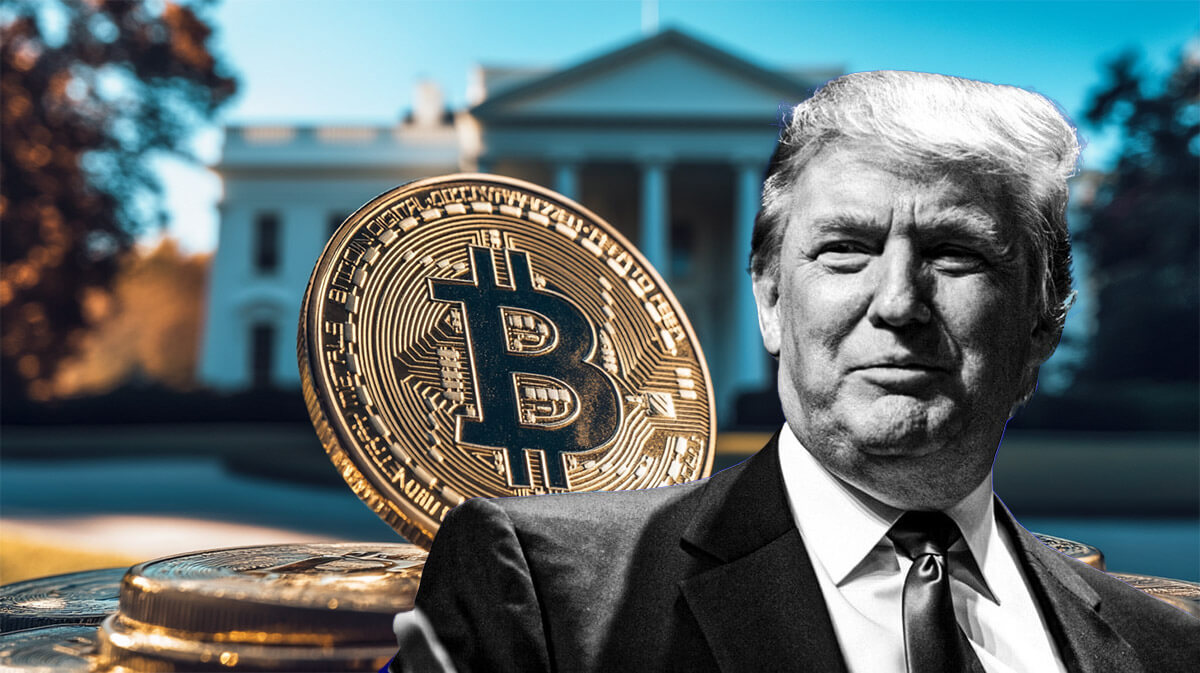
Crypto market surges $300 billion after Trump names 5 coins for strategic reserve

US President Donald Trump on social media announced the names of five digital assets he expects to include in a new US strategic reserve of cryptocurrencies on Sunday, spiking the market value of each.

Trump said in a post on Truth Social that his January executive order on digital assets would create a stockpile of currencies including bitcoin, ether, XRP, solana and cardano . The names had not previously been announced.

More than an hour later, Trump added: “And, obviously, BTC and ETH, as other valuable Cryptocurrencies, will be at the heart of the Reserve.”

Bitcoin, the world’s largest cryptocurrency by market value, was up more than 11% at USD 94,164 Sunday afternoon. Ether, the second-largest cryptocurrency, was up about 13% at $2,516.

The total cryptocurrency market has risen about 10%, or more than USD 300 billion, in the hours since Trump’s announcement, according to CoinGecko, a cryptocurrency data and analysis company.

XRP is cryptocurrency company Ripple Labs’ token. Ripple backed a so-called super PAC to influence congressional elections in November in favor of the crypto industry, Reuters reported.

“This move signals a shift toward active participation in the crypto economy by the US government,” said Federico Brokate, head of US business at 21Shares, a digital assets investment management firm. “It has the potential to accelerate institutional adoption, provide greater regulatory clarity, and strengthen the US’s leadership in digital asset innovation.”

James Butterfill, head of research at asset manager CoinShares, said he was surprised to see digital assets other than bitcoin included in the reserve.

“Unlike bitcoin…these assets are more akin to tech investments,” Butterfill said. “The announcement suggests a more patriotic stance toward the broader crypto technology space, with little regard for the fundamental qualities of these assets.”

Trump won support from the crypto industry in his 2024 election bid, and he has quickly moved to back their policy priorities. He is hosting the first White House Crypto Summit on Friday, and his family has also launched its own coins.

Under his Democratic predecessor, Joe Biden, regulators cracked down on the industry in a bid to protect Americans from fraud and money laundering.

Under Trump, the Securities and Exchange Commission has withdrawn investigations into several crypto companies and dropped a lawsuit against Coinbase (COIN.O), opens new tab, the largest crypto exchange in the US.

But in recent weeks cryptocurrency prices are down sharply, with some of the biggest digital currencies erasing nearly all of the gains made after Trump’s election win triggered a wave of excitement across the industry.

Analysts say the market needs a reason to move higher, such as signs that the US Federal Reserve plans to cut interest rates or a clear pro-crypto regulatory framework from the Trump administration.

Reuters has reported that Geoff Kendrick, an analyst at Standard Chartered, is targeting bitcoin to hit USD 500,000, against a record high of USD 109,071, before Trump leaves office.

Regulatory filings in the US showed that while hedge funds remain the dominant crypto buyers, banks and sovereign wealth funds are buying too.

Quarterly filings showed that asset managers boosted allocations to US ETFs tied to the price of spot bitcoin in the fourth quarter of 2024.

Analysts and legal experts are divided on whether an act of Congress will be necessary to set up the reserve. Some have argued the reserve could be created via the US Treasury’s Exchange Stabilization Fund, which can be used to purchase or sell foreign currencies.

Trump’s crypto group had planned to look at potentially creating the stockpile with cryptocurrencies seized in law enforcement actions.

Eqwires Research Analyst

Top-notch SEBI registered research analyst

Best SEBI registered Intraday tips provider

info@eqwires.com

Telegram Facebook Instagram

Call: +91 9624421555 / +91 9624461555

www.eqwires.com

Reliance New Energy risks being fined up to Rs 125 cr in rebuke for Ambani

A unit of billionaire Mukesh Ambani-led Reliance Industries Ltd. risks being penalised after failing to set up a battery cell plant that formed part of Indian Prime Minister Narendra Modi’s push to cut import dependence, according to people familiar with the matter. 

Reliance New Energy Ltd., among companies that won a bid for battery cell manufacturing in 2022 under an Indian government plan to reward local production, is liable to pay fines of as much as Rs 125 crore ($14.3 million) for missing a deadline, said the people who asked not to be identified because the deliberations are private.

Rajesh Exports Ltd., which also applied under this government initiative to make battery cells, is also on the hook for stalling the advanced-chemistry cell program and could be levied similar sized penalties, they said. 

The small monetary fines are a mere rap on the knuckle, especially for Asia’s richest person and his Reliance conglomerate. But the failure to reach state-directed manufacturing goals reflects the technological challenges and shifting market dynamics that can stymie Modi’s ‘Make in India’ vision to rival China as the world’s factory. 

Modi has sought to boost manufacturing to 25 per cent of gross domestic product but the share has slipped to 13 per cent in 2023 from 15 per cent in 2014.

Representatives for Reliance Industries, Rajesh Exports and India’s Heavy Industries Ministry, which overseas this initiative, didn’t respond to emails seeking comments. 

Patchy Success 

While subsidies to manufacturers under the so-called Production-Linked Incentives, or PLI, have worked well to boost local assembly of smartphones, the success hasn’t been uniform across sectors.  

Reliance New Energy, Rajesh Exports and the unit of Ola Electric Mobility Ltd. had won bids in 2022 to build the battery cell plants — part of the country’s push to reduce dependence on imports for electric vehicles — under the PLI program. 

Manufacturers were eligible for Rs 18,100 crore worth of subsidies on meeting milestones for the project that sought to create a cumulative 30 gigawatt-hour capacity of advanced chemistry cell battery storage.

The firms were required to achieve a minimum ‘committed capacity,’ along with local value addition of 25 per cent within two years of the agreement, and 50 per cent within five years, the people said. 

The third player in the mix, however, billionaire Bhavish Aggarwal’s Ola Cell Technologies Pvt. has made progress on its commitments under this PLI program.  

The Ola unit started trial production in March last year and plans to start commercial production of lithium-ion cells in the April to June quarter, a spokesperson for Ola Electric said in an emailed response. “We are well on track to meet the set timelines,” he said.

‘Risky to Invest’ 

The Reliance unit, meanwhile, has turned its focus to green hydrogen, a fuel seen as key to a carbon-free future, as part of a shift in the company’s priorities, the people said. The companies are also yet to firm up the technology needed to manufacture lithium-ion cells locally. 

“It was quite risky to invest in cell manufacturing last year – too much uncertainty with a lot of global overcapacity and uncertain trade environment,” Jiayan Shi, a BloombergNEF analyst, said. 

Also, the capital investment needed for building lithium-ion battery plants is very high, ranging from $60 to $80 million per gigawatt-hour, she added.  

Moreover, global lithium-ion phosphate, or LFP, battery prices have been on the decline. This has made imports of cells cheaper than ever, creating uncertainty around domestic demand and slowing the pace of investments in India. 

Although Reliance New Energy did acquire sodium-ion cell maker Faradion in 2021 and Netherlands-based Lithium Werks, including its manufacturing facilities in China, in 2022, they represented small investments.

Eqwires Research Analyst

Top-notch SEBI registered research analyst

Best SEBI registered Intraday tips provider

info@eqwires.com

Telegram Facebook Instagram

Call: +91 9624421555 / +91 9624461555
www.eqwires.com

Manufacturing PMI dips to 14-mth low in Feb as new orders, production fall

After a strong start to 2025, Indian manufacturers saw a loss in new orders and production momentum in February, with the Purchasing Managers’ Index (PMI) plummeting to a 14-month low of 56.3, a private survey showed on Monday. 

The manufacturing PMI was 57.7 in January. The data was released by HSBC and compiled by S&P Global.  

However, the survey noted that despite slowing to the weakest since December 2023, rates of expansion in output and sales remained elevated in the context of the survey’s 20-year history. Business conditions improved across all three monitored sub-sectors, consumer, intermediate and investment goods.

“Favourable domestic and international demand prompted firms to increase purchasing activity and hire extra workers at above-trend rates. However, demand buoyancy kept charge inflation at an elevated level despite softer cost pressures,” the survey noted.  

A figure above 50 in the index denotes expansion in manufacturing activity during the month and below it signifies contraction.

Pranjul Bhandari, chief India economist, HSBC, said that India recorded a manufacturing PMI in February which was down slightly from the prior month, but still firmly within expansionary territory as robust global demand continues to boost growth in the Indian manufacturing sector, which increased its purchasing activity and employment.

“Business expectations also remained very strong, with nearly one-third of survey participants foreseeing greater output volumes in the year ahead. Although output growth slowed to the weakest level since December 2023, overall momentum in India’s manufacturing sector remained broadly positive in February,” she added. 

The survey noted that February data marked expansion in new business intakes for the 44th consecutive month, which panel members linked to strong client demand and efforts to price better than their competitors.  

The survey noted that new export orders rose strongly in February, as manufacturers continued to capitalise on robust global demand for their goods. Although softer than January’s near 14-year high, the pace of expansion was sharp.

As a result, manufacturers continued to expand their workforce in February, extending the current period of employment growth to a year. 

“The rate of job creation was the second-best in the series history, behind only that recorded in January. One-in- ten firms signalled greater recruitment activity, while 1 per cent of companies shed jobs,” the survey noted.

Regarding input costs, the survey noted that Indian manufacturers faced another round of rise, with frequent reports of greater bamboo, leather, marketing, rubber and telecom prices. 

“Encouragingly, the overall rate of inflation eased for the third straight month to its weakest in a year. Concurrently, the rate of charge inflation was little changed from January, remaining above both its long-run average and that seen for input costs. Qualitative data showed that firms passed on higher labour costs to clients, facilitated by favourable demand conditions,” the survey concluded.

Eqwires Research Analyst

Top-notch SEBI registered research analyst

Best SEBI registered Intraday tips provider

info@eqwires.com

Telegram Facebook Instagram

Call: +91 9624421555 / +91 9624461555

www.eqwires.com