
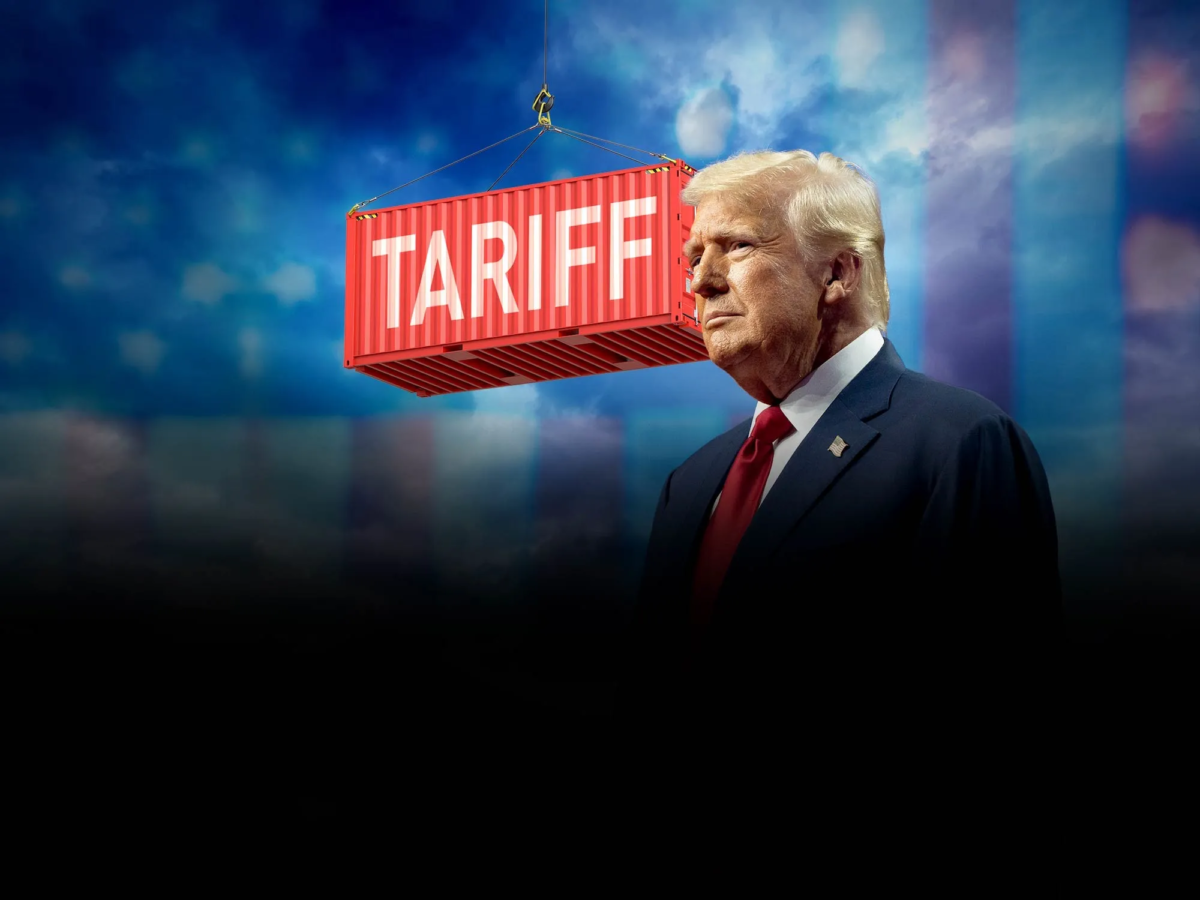
Dow Jones ends 1% higher in a session marred by wild swings ahead of Trump tariff announcements

Benchmark indices saw wild swings on Monday to end what was a dismal quarter on Wall Street a day ahead of US President Donald Trump’s reciprocal tariff announcements.

The Dow Jones recovered 900 points from the day’s low to end with gains of over 400 points. The S&P 500 and the Nasdaq also clawed back their losses from earlier in the session. Investors seeking safer bets led to a surge in Dow constituents Coca-Cola and Walmart.

US shares saw their worst quarter compared to the rest of the world since 2009.

Energy producers joined a rally in oil as Trump suggested the US may work to curtail crude shipments from Russia. A gauge of the “Magnificent Seven” megacaps extended a quarterly rout to 16% amid lingering concerns of an artificial-intelligence bubble.

It was the first time since the onset of the pandemic in March 2020 that bonds rose and stocks fell in a three-month period. The dollar, long a go-to hiding place during market selloffs, has not been acting as such lately. While the greenback saw a mild gain Monday, it suffered the worst start to a year since 2017.

The Trump administration’s mixed messaging on what new tariffs will be unveiled Wednesday and how they’ll be announced have traders flustered as they try to position around the biggest risk confronting the market in years.

Trump’s top spokesperson said the announcement would feature “country-based” tariffs, but added that the president is also “committed” to implementing sectoral duties at another time.

“Tariffs will likely continue to drive the market discussion,” said Chris Larkin at E*Trade from Morgan Stanley. “Whether tariffs are more or less rigid than expected could go a long way toward shaping the market’s near-term momentum.”

The yield on 10-year Treasuries declined three basis points to 4.22%. The Bloomberg Dollar Spot Index rose 0.2%. Gold topped $3,100 for the first time.

Ed Yardeni of eponymous firm Yardeni Research cut his year-end estimate on the S&P 500 to 6,000 from 6,400, saying Trump’s tariffs have heightened recession risks. The gauge close at 5,611.85 Monday.

“A happy outcome would be that the US would negotiate tariff reductions, but that won’t happen if the US slaps a 20% tariff on all imports across-the-board,” Yardeni said.

Amid all the concern about the economic impacts of tariffs, Goldman Sachs Group Inc.’s David Kostin now expects the S&P 500 to end the year around 5,700 versus his previous estimate of 6,200.

A stock-market signal is flashing a warning to investors hoping for a speedy recovery from this year’s sharp equity selloff.

The correlation between individual S&P 500 — measuring the degree to which they move in tandem — stands near the lowest level in 25 years even after rising this month, according to data compiled by independent strategist Jim Paulsen.

The S&P 500 briefly sank below the first ominous milestone traders were watching at the start of the session — 5,504.65, the intraday low touched on March 13. But the broad equities benchmark quickly reclaimed that level. The question now is whether it stays there.

Technical strategists also recommend keeping an eye on market breadth, looking for more evidence of washed-out conditions. A 10% or less reading in the percentage of stocks trading above their 20-day moving average would be “a good sign of a capitulation,” said Adam Turnquist, chief technical strategist at LPL Financial.

Eqwires Research Analyst

Top-notch SEBI registered research analyst

Best SEBI registered Intraday tips provider

info@eqwires.com

Telegram Facebook Instagram

Call: +91 9624421555 / +91 9624461555

www.eqwires.com

Centre appoints IFS officer Nidhi Tewari as PM Modi’s private secretary

The government on Saturday issued a memorandum announcing the appointment of Nidhi Tewari, a 2014-batch Indian Foreign Service (IFS) officer, as Private Secretary to Prime Minister Narendra Modi. 

Tewari has been serving as Deputy Secretary in the Prime Minister’s Office (PMO) since November 2022. Earlier she was Under Secretary at Disarmament and International Security Affairs Division at the Ministry of External Affairs (MEA).

According to the memorandum issued by the Department of Personnel and Training (DoPT) on March 29, the Appointments Committee of the Cabinet has approved her appointment with immediate effect.

Eqwires Research Analyst

Top-notch SEBI registered research analyst

Best SEBI registered Intraday tips provider

info@eqwires.com

Telegram Facebook Instagram

Call: +91 9624421555 / +91 9624461555

www.eqwires.com

India inflows hit 6-month high at $419 mn as US funds see $19 bn redemption

India has emerged as the standout performer, with dedicated inflows surging to a six-month high of $419 million. This influx follows 11 consecutive weeks of redemptions, totaling $3.6 billion, shows data analysed by Elara Capital.  

The inflows were largely driven by U.S.-domiciled funds. 

Notably, $239 million of the inflow was directed toward Exchange-Traded Funds (ETFs), while $180 million flowed into long-only funds. Small-cap funds, in particular, saw a notable surge, with $88 million in inflows, marking the highest figure since January 2024. This influx of funds into India is a sharp contrast to the situation in China, which saw a significant outflow of $532 million during the same period.

What this means? 

India just got a huge boost, with $419 million flowing into its markets, which is the highest it’s been in the last six months. This is especially interesting because for the past couple of months, investors were actually pulling money out of India. Now, people from the U.S. have started putting money back into India, particularly in smaller companies. 

On the other hand, U.S. markets experienced a $19 billion pullout last week, meaning investors took that much money out of U.S.-based funds. This came after a long period of big investments, so it’s like people are getting a little cautious and pulling some money out. Even though this is a big number, experts are still confident that overall, U.S. markets are doing well.

While the U.S. market saw $19 billion in redemptions last week, after a 13-week streak of large inflows amounting to $33 billion, the broader trend of inflows into U.S. markets remains resilient. However, concerns are mounting as the U.S. flow momentum indicator lingers in the “euphoria zone,” a level that historically has signaled caution. ETF flows, in particular, have been a reliable precursor to market corrections in the past. For example, a peak in ETF flows in November 2021 was followed by a 28% decline in the S&P 500, while similar patterns in 2017 and 2015 preceded significant market pullbacks.

Despite these occasional fluctuations in U.S. fund flows, the broader trend remains positive, suggesting continued investor confidence in the U.S. market. The $19 billion redemption may simply be a natural market correction. 

Meanwhile, foreign fund flows into Europe have remained robust for the 13th consecutive week. However, despite these sustained inflows, the European index has yet to surpass its highs from the year 2000, indicating that investor sentiment in the region remains cautious despite the inflows. In Japan, foreign investment continues to be strong, with the Nikkei 225 index trading near levels not seen since 1990, reflecting the ongoing attraction of Japanese assets.

In a broader context, emerging market (EM) technology funds have seen a notable resurgence in recent weeks, with $2.5 billion pouring in over the last week alone. This marks the largest inflow into EM tech since October 2024, signaling a positive shift after a challenging period from October 2024 to February 2025, when significant outflows were recorded. This improvement in the trend of EM tech funds highlights a growing optimism among investors toward technology in emerging markets.

Eqwires Research Analyst

Top-notch SEBI registered research analyst

Best SEBI registered Intraday tips provider

info@eqwires.com

Telegram Facebook Instagram

Call: +91 9624421555 / +91 9624461555

www.eqwires.com

Elon Musk sees Tesla as ‘buying opportunity’ despite DOGE blowback

Elon Musk acknowledged that his job as head of President Donald Trump’s effort to cut the size of government is “costing me a lot” when it comes to his other big job, as CEO of Tesla Inc. 

Political backlash from Musk’s recent political forays in the US and around the world have weighed on Tesla at home and abroad. “It’s costing me a lot to be in this job,” Musk said at a town hall event in Wisconsin, noting some of his political opponents have highlighted the stock’s retreat. 

“What they’re trying to do is put massive pressure on me, and Tesla I guess, to you know, I don’t know, stop doing this,” Musk said. “My Tesla stock and the stock of everyone who holds Tesla has gone, went roughly in half. I mean it’s a big deal.” 

Tesla shares rose to a record high in the month after Trump was elected, but have dropped 45 per cent since their Dec. 17 peak. While he remains the world’s richest man, Musk’s own personal wealth has declined by more than $100 billion this year, according to the Bloomberg Billionaires Index.

“Long term I think Tesla stock’s going to do fine, so maybe it’s a buying opportunity,” Musk said.  

Musk spoke in Wisconsin ahead of a state supreme court election April 1. Though the election is officially nonpartisan, Republicans including Trump have backed Brad Schimel, against Dane County Judge Susan Crawford, who has been endorsed by Democrats. Musk has thrown more than $14 million into the contest, on Schimel’s behalf, according to the Milwaukee Journal Sentinel newspaper.  

On stage, Musk handed out checks for $1 million to two local voters, and outlined how volunteers could get paid by a group he funds to canvass for Schimel in the race’s closing days.

The race will likely determine the ideological balance of the swing state’s highest court, where the liberal-leaning bloc currently holds a 4-3 edge. Wisconsin Senator Ron Johnson, a Republican, said over the weekend that if Schimel wins, Musk will be to thank for it.  

The contest could tip the balance on issues from abortion to redistricting. Musk warned repeatedly that a future adverse redistricting ruling in Wisconsin, where the GOP holds six of the state’s eight congressional districts, could threaten Republican control of the US House. 

Among the other cases the court may eventually consider is one involving Tesla, which is seeking to open additional dealerships in the state yet has so far been unable to secure an exemption from the state’s law that largely prohibits auto manufacturers from directly selling to the public.

Eqwires Research Analyst

Top-notch SEBI registered research analyst

Best SEBI registered Intraday tips provider

info@eqwires.com

Telegram Facebook Instagram

Call: +91 9624421555 / +91 9624461555

www.eqwires.com

SEBI sets new guidelines for intraday index derivative monitoring from April 1, delays penalties

Under the new guidelines, exchanges will monitor these positions by taking at least four snapshots of market positions during the trading day, with the timing of these snapshots to be randomly selected within pre-defined windows.

Markets regulator Securities and Exchange Board of India (SEBI) has instructed stock exchanges to begin monitoring the existing position limits for index derivatives on an intraday basis starting April 1, 2025. However, there will be no penalties for breaching these limits until further notice, the regulator clarified in a recent circular. 

Under the new guidelines, exchanges will monitor these positions by taking at least four snapshots of market positions during the trading day, with the timing of these snapshots to be randomly selected within pre-defined windows. The regulator has stated that exchanges can increase the number of snapshots beyond the minimum requirement but must ensure that at least four are taken each day.

“However, there shall be no penalty for breach of existing position limits intra-day and such intraday breaches shall not be considered as violations, until further directions,” SEBI added in its statement.

This move comes in response to concerns raised by industry associations, which pointed out the readiness challenges faced by stock brokers and clients in monitoring existing position limits intraday. The groups also noted that market systems are still adapting to proposed changes outlined in SEBI’s consultation paper released in February. This paper suggests the introduction of delta-based or futures-equivalent limits for index derivatives, which could significantly impact the industry’s existing infrastructure.

SEBI acknowledged these concerns, explaining that implementing systems for monitoring notional position limits during the day could put additional strain on market participants in the interim, particularly as higher intraday limits have been proposed compared to current end-of-day limits. 

In February, SEBI proposed several measures to enhance market risk management and improve trading efficiency, including real-time monitoring of Futures & Options (F&O) Open Interest. These measures aim to provide market participants with the tools to make more informed decisions and manage risks more effectively.

As part of these proposed changes, SEBI outlined new position limits for index derivatives. For index options, the end-of-day limits are set at Rs 500 crore (net) and Rs 1,500 crore (gross), while the intra-day limits are Rs 1,000 crore (net) and Rs 2,500 crore (gross). For index futures, the end-of-day limit has been increased from Rs 500 crore to Rs 1,500 crore, with an intra-day limit of Rs 2,500 crore. These limits would apply to all market participants, including FPIs, mutual funds, traders, and clients, ensuring a standardized framework.

Guidelines on fast-track follow-on offer by REITs, InvITs

In other regulatory developments, SEBI has also introduced a framework to fast-track follow-on offers (FPOs) for Real Estate Investment Trusts (REITs) and Infrastructure Investment Trusts (InvITs). Under this framework, SEBI has set lock-in periods for sponsors receiving preferential issues of REIT and InvIT units. A three-year lock-in applies to 15% of the units allotted to sponsors and sponsor groups, while the remaining units will be locked in for one year. Additionally, SEBI has clarified rules for inter-group transfers within REITs or InvITs.

The FPO mechanism enables REITs and InvITs to raise additional funds after their initial public offerings (IPOs). The new rules take effect immediately, with provisions covering listing approvals, offer documents, and minimum public unit holding requirements. For REITs and InvITs to proceed with an FPO, they must seek in-principle approval from the stock exchanges where their units are listed and file the necessary documents with SEBI after obtaining approval from merchant bankers.

Eqwires Research Analyst

Top-notch SEBI registered research analyst

Best SEBI registered Intraday tips provider

info@eqwires.com

Telegram Facebook Instagram

Call: +91 9624421555 / +91 9624461555

www.eqwires.com