
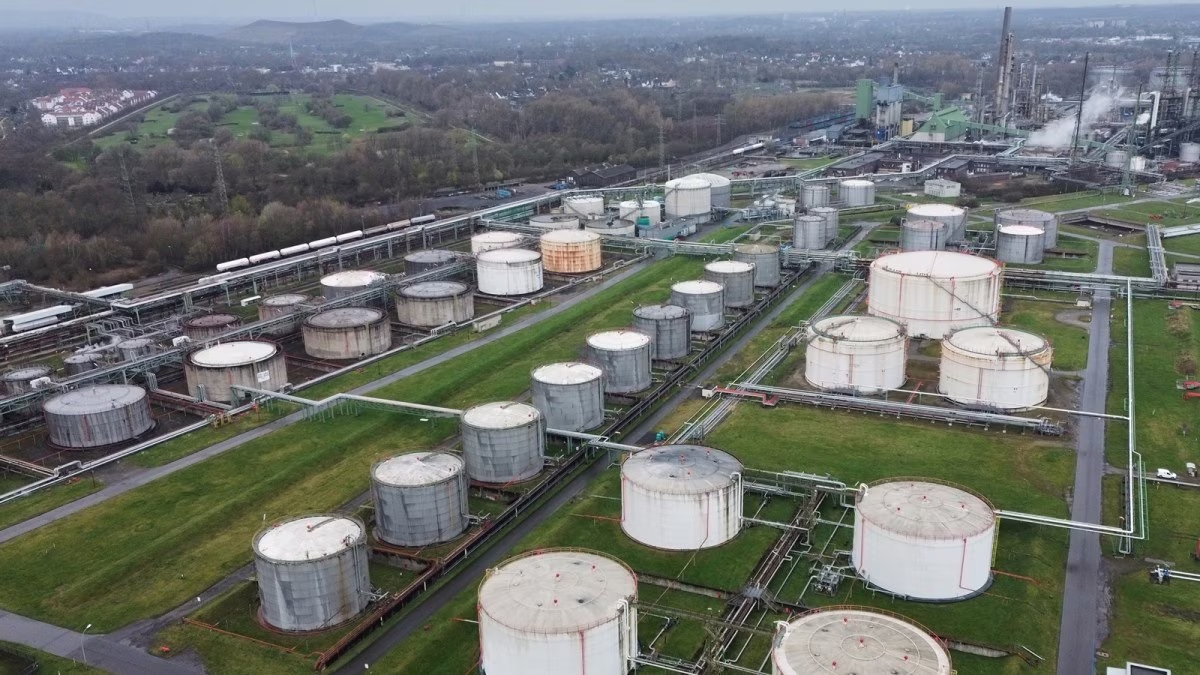
The International Energy Agency (IEA) has officially triggered the largest coordinated emergency oil release in its history, authorizing the deployment of 400 million barrels from strategic reserves. This unprecedented move, finalized on March 11, 2026, aims to stabilize a global energy market reeling from the effective closure of the Strait of Hormuz. While the sheer volume is more than double the 182-million-barrel release seen during the 2022 Russia-Ukraine crisis, a critical question looms over the global economy: Is it enough to avert a long-term energy catastrophe?
The Scale of the Disruption
The current crisis, sparked by intensifying military conflict in West Asia involving the United States, Israel, and Iran, has paralyzed one of the world’s most vital energy chokepoints. Under normal conditions, the Strait of Hormuz handles approximately 20 million barrels per day (mb/d) of crude and refined products—roughly 25% of the world’s seaborne oil trade.
According to the IEA, global oil supply is projected to plunge by 8 mb/d in March 2026 alone. Iranian threats and the risk to maritime shipping have reduced traffic to a “trickle,” forcing major producers like Saudi Arabia, Iraq, and the UAE to shut in production as storage facilities behind the chokepoint reach capacity.
Market Reaction: A Fleeting Respite?
The announcement initially pulled Brent crude down from a peak of $119 per barrel to approximately $90. However, the relief was short-lived. By March 12, prices surged back above the $100 mark as news of further attacks on tankers in Iraqi waters reached traders.
Market analysts remain skeptical for several reasons:
- Duration vs. Volume: The 400 million barrels represent only about four days of global oil production.
- Daily Flow Gap: If the reserves are released over two months, they would add roughly 6.6 mb/d to the market. While significant, this still fails to fully cover the 15–20 mb/d currently missing from the Hormuz transit route.
- Infrastructure Risks: Persistent attacks on refineries and pipelines in the Gulf mean that even if the water routes reopen, the physical capacity to process and transport oil may be compromised for months.
Global Contributions and National Impacts
The 32 member countries of the IEA reached a unanimous decision to tap into their public and industry-held stocks, which collectively total 1.8 billion barrels.
| Country | Contribution (Million Barrels) |
| United States | 172 |
| Japan | 80 |
| South Korea | 22.46 |
| Germany | 19.5 |
| United Kingdom | 13.5 |
India, an associate member of the IEA, has welcomed the move and is coordinating its own domestic strategy to stabilize fuel prices. However, the IEA has warned that in the absence of a swift diplomatic or military resolution to the conflict, this record-breaking release remains a “stop-gap measure” rather than a permanent solution.
In an era of unprecedented geopolitical shifts and extreme market volatility, making the right financial moves requires precision and verified expertise. If you are looking for professional advice, consider the Best SEBI-Registered Research Analyst in India. By partnering with the Best SEBI-Registered Eqwires Research Analyst, investors gain access to the Best Investment Strategies by Eqwires Research Analyst, specifically designed to withstand global shocks. As the Best Stock Market Service Provider in India and the Best Options Trade Provider, Eqwires ensures your portfolio remains resilient. Choose the Best SEBI-Registered Company in India to secure your financial future today.
Top-notch SEBI registered research analyst
Best SEBI registered Intraday tips provider
Telegram | Facebook | Instagram
Call: +91 9624421555 / +91 9624461555