
IndusInd Bank up 36% from April low. Buy, sell, hold? Check strategy here

IndusInd Bank stock surged over 3 per cent to ₹ 864 in intra-day deals on Friday, and was the top gainer among banks in the Sensex that gained nearly a per cent to hit the 81,000 mark. On the other hand, In comparison, the Nifty Bank index was trading around 0.8 per cent higher in intraday trade at 55,508 levels. 

IndusInd Bank stock has zoomed nearly 36 per cent from its April-month low of ₹ 637.

IndusInd Bank has been in the news amid resignations of the top management. The bank’s Managing Director (MD) and Chief Executive Officer (CEO) Sumant Kathpalia, and Deputy Chief Executive Officer Arun Khurana had resigned last week. 

The Reserve Bank of India (RBI) then approved the formation of a temporary leadership team at IndusInd Bank. The developments follow accounting lapses that triggered a sharp fall in the stock in April. 

Given this background, what should be your trading strategy in IndusInd Bank stock? Should you buy, sell or hold IndusInd Bank stock? Here’s what the technical chart suggests. 

IndusInd Bank

Current Price: ₹ 859 
Upside Potential: 9.9% 
Downside Risk: 12.7% 
Support: ₹ 822; ₹ 763 
Resistance: ₹ 901; ₹ 944 

IndusInd Bank stock is seen trading above its 50-Daily Moving Average (50-DMA), which stands at ₹822, for the last three trading sessions. That apart, the stock also trades firmly above its 20-DMA (₹ 763), and saw a positive breakout in mid-April above ₹ 740 levels – since then the stock has gained 16.5 per cent in the last 11 trading sessions. 

Technically, the stock short-term bias for the stock is expected to remain positive as long as the stock sustains above ₹ 750 – ₹ 763 support zone. However, chart shows that the stock may see limited gains on the upside owing to presence of major hurdles. 

The stock is now seen nearing its crucial 100-DMA resistance, a key hurdle the stock has been languishing below for the last seven months. The 100-DMA resistance now stands at ₹ 901 levels. Above which, the up side for the stock seems capped around ₹ 944 levels – wherein stands the weekly super trend line hurdle – a key indicator the stock has failed to conquer for more than a month.

Eqwires Research Analyst

Top-notch SEBI registered research analyst

Best SEBI registered Intraday tips provider

info@eqwires.com

Telegram Facebook Instagram

Call: +91 9624421555 / +91 9624461555

www.eqwires.com

Apple shifts iPhone production for US market to India, confirms Tim Cook

Tech giant Apple is procuring half of its iPhones for its US market from India, as the tariffs are lower than in China, its Chief Executive Officer (CEO) Tim Cook said. 

Speaking to CNBC after quarterly earnings, Tim Cook also added that it is sourcing its other products from Vietnam for its US market. However, he added, the company still makes the “vast majority” of its products for other countries in China. 

Cook also confirmed that India will be the ‘country of origin’ for a large number of iPhones that will be sold in the US. This comes as the country tries to move away from China, owing to its high tariff rates as compared to the 10 per cent tariffs imposed on Indian and Vietnamese-made goods.

Why Apple is moving iPhone production away from China’s high tariffs

Tim Cook’s remarks follow US President Donald Trump’s announcement of reciprocal tariffs. Talking about the impact on the company, Cook said that it saw a “limited” effect in the March quarter, as Apple was able to optimise its supply chain. 

iPhones to cost less if production is moved to India

An India Dispatch report citing JPMorgan analysis suggests that the tech giant would be able to keep the price of its phones almost the same if it completes the final steps of moving the facility to India. A cost breakdown suggests that iPhones assembled in China cost $938, whereas it would cost $1,008 if the production were moved to India. This increase of 2 per cent in the prices is relatively cheaper as compared to the 30 per cent hike in the prices of iPhones, if the company decides to manufacture phones in the US. 

A report from the Financial Times suggests that Apple is planning to shift the assembly of all of its US-sold iPhones to India by 2026 as the company pivots away from China following a trade war between the two countries. Following Trump’s tariff announcement, the company witnessed a wipeout of $700 billion from its market value. 

This comes after the company spent almost two decades in China and spent heavily on creating a production line which helped the company to become a $3 trillion tech giant. 

Moving its assembly to India would mean that the company would have to double its production output. In 2024, Apple sought to pivot towards India for the production of its iPhones, for which its main supplier, Foxconn, and Tata started importing already assembled component sets from China. 

Apple Q2 results: Revenue grows to $95.4 billion, iPhone leads the charge

For the quarter ending March, Apple reported revenue of $95.4 billion, up from $90.75 billion a year ago. iPhone revenue stood at $46.84 billion. Mac revenue was $7.95 billion, while iPad revenue was reported at $6.4 billion. 

In the current quarter, ending in June, Cook expects overall revenue to grow in the “low to mid-single digits” on an annual basis. However, he admitted that forecasts beyond June are murky, indicating that the tariff situation remains fluid. 

The company follows a fiscal year cycle that begins in October and ends in September. The first quarter is from October to December, and the results were reported in January. 

Trump’s reciprocal tariffs: What it means for Apple and iPhone supply chains

On 2 April, Trump announced reciprocal tariffs on more than 100 countries, including India and China. On 9 April, he announced a 90-day pause on these tariffs as several countries tried to negotiate a deal with the US. However, the list did not include China, which retaliated with its own reciprocal tariffs. 

Currently, the US has imposed 145 per cent tariffs on Chinese products, while China has imposed 125 per cent tariffs on US goods.

Eqwires Research Analyst

Top-notch SEBI registered research analyst

Best SEBI registered Intraday tips provider

info@eqwires.com

Telegram Facebook Instagram

Call: +91 9624421555 / +91 9624461555
www.eqwires.com

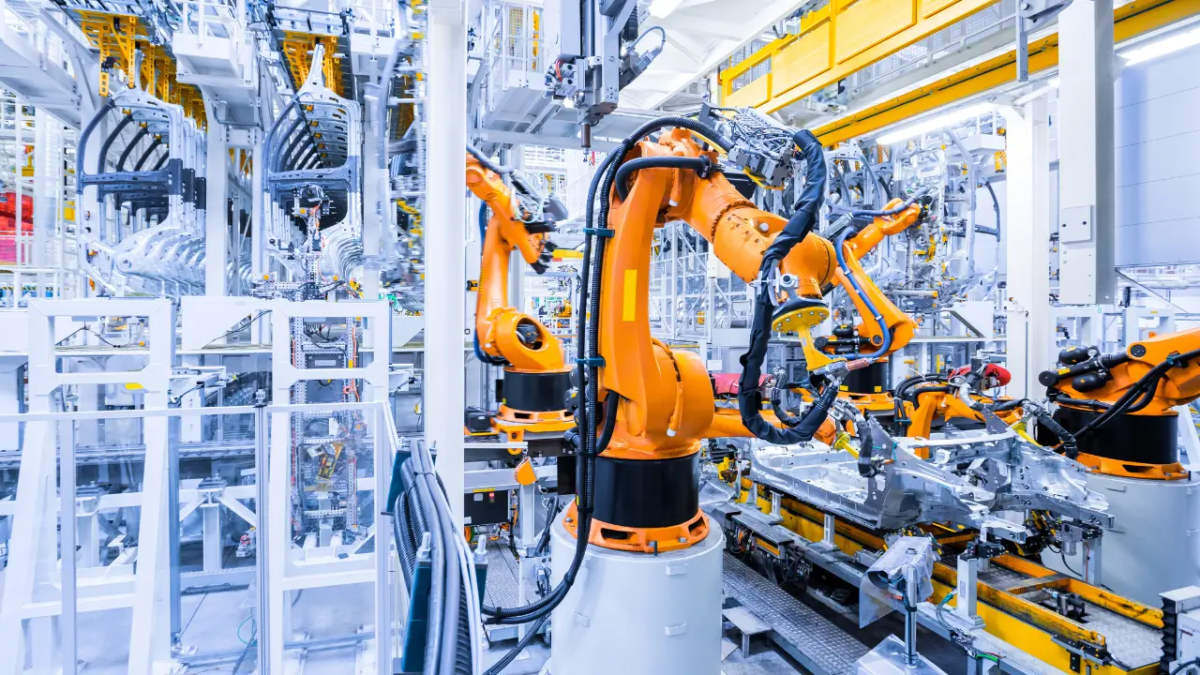
India’s manufacturing PMI hits 10-month high of 58.2 in April, IIP rebounds

India’s manufacturing sector hit a 10-month high in April 2025, despite the HSBC India Manufacturing Purchasing Managers’ Index (PMI) only rising slightly to 58.2 from 58.1 in March, according to data compiled by S&P Global on Friday.  

The seasonally adjusted index signalled the strongest improvement in the sector’s health since June 2024, driven by faster growth in employment, production, and stocks of purchases. 

This follows a dip to a 14-month low of 56.3 in February, when output, new orders, and input purchasing had slowed. 

Outputut demand, export boom drive PMI

New orders, especially from overseas, rose sharply. International demand grew at the second-fastest rate in over 14 years, with businesses from Africa, Asia, Europe, West Asia, and the Americas placing more orders for Indian goods, the HSBC survey noted. Adding that factories increased production at the fastest pace since June 2024, with consumer goods leading this growth. 

Commenting on PMI, Chief India Economist at HSBC Pranjul Bhandari, said, “The notable increase in new export orders in April may indicate a potential shift in production to India, as businesses adapt to the evolving trade landscape and US tariff announcements. Manufacturing output growth strengthened to a ten-month high on robust orders. Input prices increased slightly faster, but the impact on margins could be more than offset by the much faster rise in output prices, of which the index jumped to the highest level since October 2013.” 

Manufacturers optimistic on future growth

About 9 per cent of surveyed manufacturers hired more workers, both permanent and temporary, to meet rising demand.  Companies increased their buying activity and built up inventories to keep up with future demand. 

The April data showed strong optimism about future output, driven by expectations of higher demand. Companies were also more confident due to better marketing, improved efficiency, and more new customer enquiries.

What is manufacturing PMI?

The manufacturing PMI is a key economic indicator that reflects business activity in the sector. It is based on survey responses from purchasing managers and covers areas such as production levels, new orders, employment, supplier performance, and inventory levels. Given its forward-looking nature, PMI data is closely monitored by investors, businesses, and policymakers to assess economic trends and momentum. 

Industrial output recovers in March

Meanwhile, industrial output showed a modest recovery in March. The Index of Industrial Production (IIP) grew 3 per cent, up from February’s six-month low of 2.72 per cent. However, overall IIP growth for FY25 slowed to 4 per cent, the weakest in four years, compared to 5.9 per cent in FY24. The subdued performance highlights a broader deceleration across several industrial segments. 

In March, the uptick in IIP was supported by growth in electricity output (6.3 per cent) and a mild recovery in manufacturing (3 per cent). However, mining sector growth remained weak at just 0.4 per cent. For context, IIP had risen by 5.4 per cent in March 2024 and had contracted by 8.4 per cent during the pandemic-hit FY21.

Reserve Bank open to rate cuts

Meanwhile, the Reserve Bank of India’s Monetary Policy Committee (MPC) cut the repo rate by 25 basis points to 6 per cent in April, while shifting its stance from “neutral” to “accommodative,” signalling potential further easing. This marked the second rate cut in 2025, following a similar reduction in February to 6.25 per cent from 6.5 per cent.

The next MPC meeting is scheduled for June 4-6, 2025.

Eqwires Research Analyst

Top-notch SEBI registered research analyst

Best SEBI registered Intraday tips provider

info@eqwires.com

Telegram Facebook Instagram

Call: +91 9624421555 / +91 9624461555
www.eqwires.com

SC scraps JSW Steel’s Bhushan Power & Steel resolution, orders liquidation

The Supreme Court on Friday rejected JSW Steel’s ₹19,700-crore resolution plan for Bhushan Power and Steel Ltd (BPSL), terming it “illegal” and ordering the liquidation of the debt-ridden company.

The plan has been earlier approved by BPSL’s Committee of Creditors (CoC). On this the apex court stated that the plan violated insolvency law as JSW had used a mix of equity and optionally convertible debentures (OCDs) to fund the takeover, instead of equity alone. It also flagged the failure to implement the resolution within the stipulated timeline.

Following the verdict, JSW Steel’s shares dropped 5 per cent on the bourses. 

The verdict is a major setback for JSW Steel, which had been vying to acquire the debt-laden firm through insolvency proceedings. The court’s decision may alsohave wider implications for future resolution plans under the Insolvency and Bankruptcy Code (IBC).

Eqwires Research Analyst

Top-notch SEBI registered research analyst

Best SEBI registered Intraday tips provider

info@eqwires.com

Telegram Facebook Instagram

Call: +91 9624421555 / +91 9624461555

www.eqwires.com

Mid, smallcaps outrun large-cap peers in recent market pullback. Will it last?

Midcap and smallcap indices have outrun their large-cap peers in the recent market pullback, shows data even as markets grappled with the recent geopolitical tensions between India and Pakistan. 

From a level of 21,744 hit on April 7, 2025 on tariff fears, the Nifty 50 index has gained around 9 per cent to 24,260 levels by April 28. The Nifty Midcap 100 and the Nifty Smallcap 100 indices, however, gained over 10 per cent each during this period, ACE Equity data shows. 

The overall market pullback, according to analysts, has been on account of delay in implementation of higher tariffs by US president Donald Trump. The markets, for now, have also taken geopolitical tensions between India and Pakistan following the killing of civilians in Pahalgam recently in their stride.

The mid-and smallcap segments started to outperform once there was some clarity on the tariffs, said Ambareesh Baliga, an independent market expert. Typically in any market pullback, he said, the mid-and small-cap segments always do better as they are the favourite segments of the retail investors.

“I don’t see the overall markets continuing to move up much in the short-to-medium term due to the geopolitical situation between India and Pakistan. Tough Trump tariff fears have now gone into the background, the markets have not yet fully discounted the worst of the geopolitical concerns. As things stand, investors should sell the rallies, but should not empty out their portfolios. It is better to stay in cash for now,” Baliga advises.

Movers and shakers 

Among individual stocks that comprise the mid-and smallcap segments on the NSE, Dixon Technologies, Waaree Energies, Data Patterns (India), Godfrey Phillips India, Devyani International, AU Small Finance Bank and KFin Technologies are some of the counters that have gained over 20 per cent during the above-mentioned period, ACE Equity data shows. 

HDFC AMC, IDFC First Bank, Indiamart Intermesh, MRF, Coforge, L&T Finance, CDSL, Oil India, PVR Inox are some of the other prominent stocks that rallied between 15 per cent to 20 per cent, shows data.

Indian stock markets, according to G Chokkalimgam, founder and head of research at Equinomics Research, would continue to recover in the short-term and suggest investors focus on domestic demand-driven stocks to minimize risk. 

“Highly conservative investors might keep 50 per cent allocation to large cap (top 100) stocks as DIIs would continue to focus on the large cap segment in any possible event of market stress. Those who have an appetite for risk can consider 60 per cent to 70 per cent allocation to quality small-and mid-cap stocks with focus largely on domestic demand for possible wealth creation,” he said.

Tech view 

On the technical front, the Nifty, said Sameet Chavan, head of research (technical and derivative) at Angel One, has confirmed a strong bullish breakout on the charts as it surpassed the February-March swing highs.  

If geopolitical tensions escalate or the 23,900 – 23,800 support for the Nifty is breached, he expects a deeper correction towards the 23,500–23,300 levels.

“On the upside, while the broader trend remains bullish, Nifty has an immediate resistance at 24,250–24,350 levels. A move above this zone would confirm a continuation of the primary uptrend. Traders should stay cautious and monitor these key levels, as the next leg of the move may not be as smooth as the recent rally. A selective approach toward midcap stocks is advisable,” Chavan said.

Eqwires Research Analyst

Top-notch SEBI registered research analyst

Best SEBI registered Intraday tips provider

info@eqwires.com

Telegram Facebook Instagram

Call: +91 9624421555 / +91 9624461555

www.eqwires.com