
Operation Sindoor may trigger market volatility; key Sensex support here

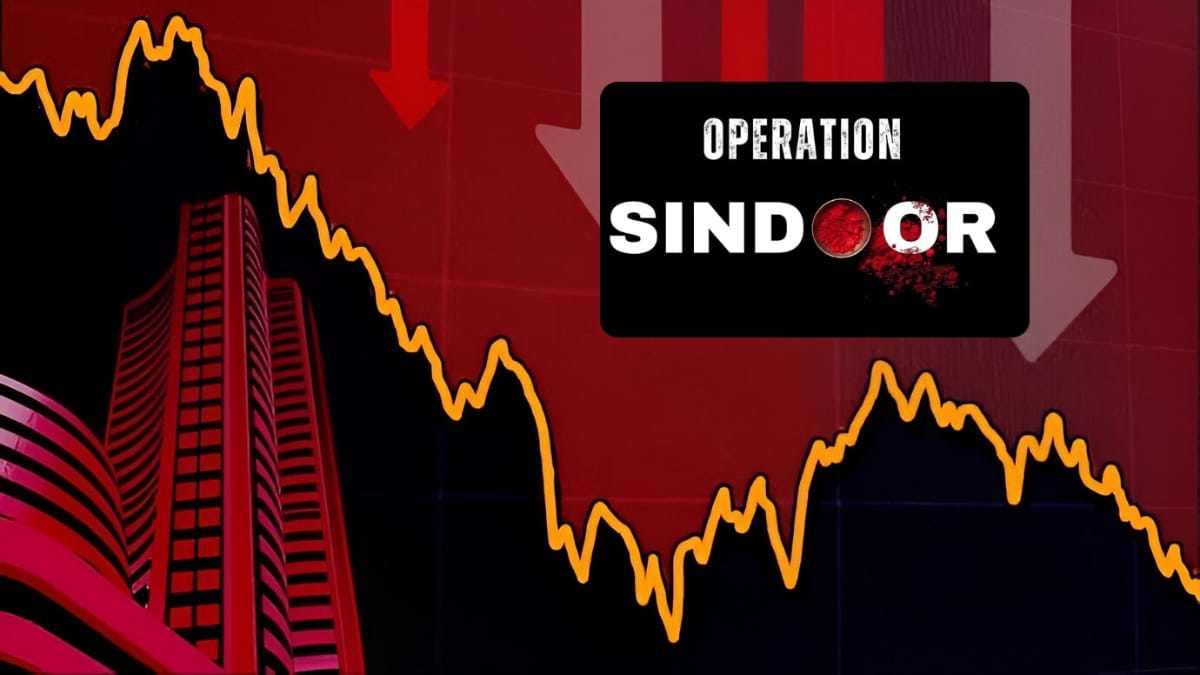
Stock Market Outlook post Operation Sindoor: Indian stock markets are likely to exhibit high volatility in the near-term as rising tensions between India-Pakistan, following India’s retaliatory action to avenge the Pahalgam terror strike in Kashmir. In the wee hours of Wednesday, the Indian armed forces launched a series of strikes under ‘Operation Sindoor’ on terror infrastructure in Pakistan and Pakistan-occupied Kashmir (PoK). A total of nine sites were targeted by the Indian armed forces, with the Indian Army shortly announcing, “Justice is served.” Following which, GIFT Nifty May futures tumbled to a low of 24,227; but since then have recovered and quoted around 24,350 levels in morning deals. Here are the key levels to watch out for on the NSE Nifty 50 index and the BSE Sensex as market brace for likely impact of rising India-Pakistan tensions. 

NSE Nifty Current Level: 24,380 Downside Risk: 6.4% Support: 24,200; 24,000; 23,700 Resistance: 24,350; 24,460; 24,589 Technical chart shows presence of near support for the Nifty at 24,200 levels; below which the index may seek support around its 200-day Simple Moving Average (200-DSMA), which stands at 24,050 levels. The overall bias for the Nifty is expected to remain favourable as long as the index holds above 23,700 levels, on a daily closing basis. Key momentum oscillators like the 14-day Relative Strength Index (RSI), the Moving Average Convergence-Divergence (MACD) and the Stochastic Slow were showing signs of tiring out, post the recent 13 per cent rally in the Nifty from a low of 21,744 on April 7. The recent rally saw the Nifty gain 2,845 points in absolute terms. As per the retracement theory, a 38.2 per cent retracement of the recent rally indicates that the Nifty can potentially fall to 23,500 levels. Similarly, 50 per cent and 61.8 per cent retracement of the rally suggests a likely downside target of 23,165 and 22,830 levels, respectively. For now, upside on the Nifty may be capped around its recent high at 24,589-odd levels, with near resistance likely around 24,350 and 24,460 levels.

BSE Sensex Current Level: 80,641 Downside Risk: 4.3% Support: 79,365; 78,070 Resistance: 80,900; 81,100; 82,000 The weekly Fibonacci chart suggests key support for the BSE Sensex at 79,365 levels. Break and sustained trade below the same can potentially accentuate the fall, and the Sensex could then slide to 78,070 and 77,150 levels in the short-term. On the upside, the 80,900 – 81,100 zone shall act as the near-term resistance zone; above which the major hurdle for the BSE Sensex stands around the 82,000-mark.

Eqwires Research Analyst

Top-notch SEBI registered research analyst

Best SEBI registered Intraday tips provider

info@eqwires.com

Telegram Facebook Instagram

Call: +91 9624421555 / +91 9624461555
www.eqwires.com

Operation Sindoor: Prolonged strikes can sink markets, say analysts

A prolonged war / tension with Pakistan post Operation Sindoor – the retaliatory attack by Indian armed forces on Pakistan and Pakistan Occupied Kashmir (PoK) – could ‘sink’ markets, suggest analysts. However, they could see a recovery in due course if the measures are limited only to select targets and the tensions de-escalate, they said. 

History, Aniruddha Sarkar, chief investment officer at Quest Investment Advisors said, suggests that Indian markets have most of the times done well during and even after any conflict with Pakistan on the borders. This time is no different.

“Though the geopolitical concerns have been there for the last two weeks, yet foreign institutional investor (FII) inflows continued into our markets, which is a stamp of our economic resilience to these short-term border conflicts. Any military campaign which would be limited to selected targets and be over within a few days or weeks, would not have any negative impact on our economy or markets. Prolonged conflict, which seems unlikely at this moment, could impact investor sentiment negatively as they would prefer a risk off mode,” Sarkar said. 

In the intervening night of May 6 and May 7, Indian armed forces carried out strikes on terrorist infrastructure in Pakistan and Pakistan-occupied Jammu and Kashmir (PoJK) in response to the terrorist attack in Pahalgam on April 22 that left 26 civilians dead.

Historically, Indian equity markets have typically reacted sharply to geopolitical tensions in the short-term as a knee-jerk, but recovered quickly once uncertainties subsided. 

For example, during the Kargil conflict between India and Pakistan in mid-1999, markets experienced a significant correction. However, they rebounded strongly as it became evident that the conflict would be short-lived.

Ambareesh Baliga, an independent market analyst, too, feels that if Operation Sindoor remains localised within a band / territory with targeted strikes and ends soon, the markets could witness a smart recovery. 

“In case the current conflict widens, the uncertainty will sink the market. As of now it would be a wait-and-watch strategy. Post Balakot also, we witnessed a smart move up in the markets,” he said.

The information available till now on Operation Sindoor has been digested by the markets, feels U R Bhat, co-founder & director, Alphaniti Fintech. For the markets to stabilize, he feels, more information is needed on how Pakistan is likely to react to the developments.

“The markets are waiting with bated breath and are likely to remain volatile. While the available information has been digested by the markets, any escalation in the tensions will see them spiral down. As a strategy, investors should sell the rallies till there is truce and more clarity on the developments,” he said.

Within the market segments, G Chokkalingam, founder and head of research at Equinomics Research, said small-and mid-cap segments may underperform the large-caps as retail investors’ participation seems to be weak due to geopolitical developments. 

“Till intense tensions on border moderates, we suggest some tilt towards large-caps, especially the Sensex and Nifty stocks.  Of course, if there is any escalation or war with Pakistan, then the whole market, including large-caps may see a substantial fall,” he warns.

Eqwires Research Analyst

Top-notch SEBI registered research analyst

Best SEBI registered Intraday tips provider

info@eqwires.com

Telegram Facebook Instagram

Call: +91 9624421555 / +91 9624461555

www.eqwires.com

Mid-, Small-Cap stocks outperform; Welspun, BSE shine; check other gainers

Shares of the Mid and Smallcap companies were outperforming in an otherwise flat market on Wednesday, May 7.   The Smallcap and Midcap indices, which initially dropped nearly 1.5 per cent, reversed their losses and were now trading with gains of over 1 per cent each.  

The Nifty MidCap100 index rallied 2.87 per cent from the intra-day low to 54,242.4, while the Nifty SmallCap250 index climbed 2.71 per cent from the day’s low to an intra-day high of 16,373.6 levels on Wednesday.

BSE leads the rally

From the Midcap basket, BSE led the gains among the Nifty Midcap100 constituent stocks, trading higher by 8.64 per cent, followed by One 97 Communications, the parent company of Paytm, with a 7 per cent rise, at around 12 PM on Wednesday. Muthoot Finance, SRF, and Aditya Birla Fashion were among the other gainers that traded higher by over 3 per cent each.

Meanwhile, from the Smallcaps space, Welspun Living logged the highest demand, trading higher by 13 per cent. This was followed by Piramal Enterprises (8 per cent), IIFL Finance (5.82 per cent), Kfin Technologies (5 per cent), Poonawalla Fincorp (4.8 per cent), and PG Electroplast (4.75 per cent). 

Analyst advises caution

The outperformance in mid- and small-cap stocks, Prashanth Tapse, Sr VP research analyst at Mehta Equities, said, is being driven by better-than-expected Q4 earnings, renewed optimism from easing global trade tensions (notably the India-UK FTA), and steady foreign investments, all of which have boosted investor confidence.

“Further supporting the rally are declining crude oil prices and expectations of lower interest rates, which are poised to benefit the Indian economy by easing inflationary pressures and improving corporate earnings in upcoming quarters,” said Tapse.

Ravi Singh, SVP of retail research at Religare Broking, sees this as a pullback rally after the recent correction in the mid- and small-cap stocks. Notably, the Nifty Midcap100 and Smallcap100 indices had settled lower by over 2 per cent each on Tuesday, May 6. 

“In this volatile environment, investors can use derivatives to hedge against downside risk or capitalize on increased market volatility. Amid escalating geopolitical tensions, nations are increasingly prioritizing defense preparedness, resulting in a significant global surge in military spending. This trend, especially in the context of ongoing tensions with Pakistan, is expected to have long-term momentum,” said Singh.

Given the current global uncertainties, Singh advises maintaining higher levels of cash or liquid assets, as it enables swift responses to rapidly evolving conditions. A cautious approach—both in terms of current holdings and new investments—is recommended. 

Going forward, Tapse recommends adopting a sell-on-rise strategy amid continued market volatility and headline risk, while he urges long-term investors to view market dips as opportunities to accumulate high-quality, fundamentally strong businesses for medium to long-term wealth creation. 

That said, despite today’s gains, the Nifty Midcap100 and Nifty Smallcap100 indices, for the year-to-date, have logged losses of 5.25 per cent and 12.8 per cent respectively. In contrast, the benchmark Nifty50 has advanced 2.5 per cent this year.

Sensex, Nifty today

The benchmark Indian equity indices were trading on a flat note. The BSE Sensex was quoted trading at around 80,559.70 levels, down by 84 points or 0.10 per cent. The index has traded in the range of 80,844.63 – 79,937.48 today. 

Tata Motors (3.88 per cent), Titan (1.56 per cent), and Power Grid Corporation (1.40 per cent) were among the top gainers of Sensex constituent stocks, while Sun Pharma (down 1.20 per cent), Asian Paints (1.27 per cent), and ITC (1 per cent) were among the top laggards of Sensex constituent stocks. 

Meanwhile, NSE Nifty50 traded lower by merely 15 points or 0.06 per cent at 24,363 levels.

Sectoral markets update

The sectoral indices too were buzzing in trade with gains led by Auto, Metal, and Consumer Durables stocks. Barring Nifty FMCG (down 0.56 per cent), Pharma (down 0.35 per cent), and Healthcare index (0.26 per cent), all the other sectoral indices were trading higher. 

Among them, Nifty Auto, Metal, and Consumer Durables were trading higher by over 1 per cent each. Meanwhile, Banking, Oil & Gas, Financial Services, and Realty indices were trading in the range of 0.13–0.60 per cent.

Eqwires Research Analyst

Top-notch SEBI registered research analyst

Best SEBI registered Intraday tips provider

info@eqwires.com

Telegram Facebook Instagram

Call: +91 9624421555 / +91 9624461555

www.eqwires.com

Nifty can see a BIG BREAKOUT from here on; charts hint at this target

The NSE Nifty 50 index surged over 1 per cent in intra-day deals on Friday to hit a high of 24,589 – its highest point in calendar year 2025. The index, however, trimmed gains as trade progressed as investors took profits off the table. 

The Nifty has rallied by 13 per cent from its April 7 low of 21,744 in less than a month. In doing so, the Nifty this Friday stands on the brink of a major technical breakout on the charts after 28 weeks – i.e. since October 25, 2024. 

The Nifty is seen quoting firmly above its weekly super trend line resistance, which stands at 24,169 – a key technical indicator the NSE benchmark has been languishing below for the last 28 weeks. A close above 24,169 today shall confirm the breakout on the weekly chart. 

The weekly super trend line is a key technical indicator as it helps in determining the medium-term trend of the underlying index or stock. In general, stocks or indices quoting above this key indicator are said to be trading with a positive bias, and vice versa.

Given this background, here’s what likely may happen in the event of a successful breakout on the Nifty. 

Nifty 

Current Level: 24,440 
Upside Potential: 6% 
Support: 24,051; 23,550; 23,300 
Resistance: 24,800; 24,980; 25,200 

Technically, a breakout on the weekly scale for the Nifty shall open the doors for a likely rally towards 25,900 levels; above which a new high cannot be ruled out. Chart shows the index could face interim resistance around 24,800, 24,980 and 25,200 levels.

The short-term bias for the index is expected to remain favourable as long as the index holds above 23,550, with near support anticipated around the 200-Day Simple Moving Average (200-DSMA) at 24,051 levels. Whereas, the medium-term chart indicates strong support for the index at 23,300 levels.

Sensex 

Current Level: 80,700 
Upside Potential: 6.7% 
Support: 79,190; 78,150; 77,400 
Resistance: 82,000; 82,400; 83,770; 84,240; 84,860 

With today’s high at 81,173, the BSE Sensex has triggered a ‘Buy’ signal on the quarterly Fibonacci chart, by surpassing its quarterly Resistance-2 (R-2). Technically, the Sensex shall now target the R-3 level, which stands at 82,000-mark. 

The 82,000-mark, may offer stiff resistance in the near-term, as it coincides with the yearly hurdle at 81,900 levels. Break and sustained trade above the same, can potentially trigger a rally towards 86,100 levels. Interim resistance for the index can be anticipated around 82,420, 83,770, 84,240 and 84,860 levels. 

The near-term bias for the Sensex is expected to remain favourable as long as the index holds above 79,170 levels; below which the Sensex shall seek support around 78,150 and 77,400 levels.

Eqwires Research Analyst

Top-notch SEBI registered research analyst

Best SEBI registered Intraday tips provider

info@eqwires.com

Telegram Facebook Instagram

Call: +91 9624421555 / +91 9624461555

www.eqwires.com

Musk’s next challenge? Reviving Tesla as Europe sales plunge 50% in a year

Tesla sales plunged by more than half last month in several European countries in a sign that Elon Musk could struggle to revive the company after he shifts from his Washington work to running the automaker again.

Tesla sales collapsed in April by more than two-thirds from a year earlier in Sweden, the Netherlands and Denmark, according to auto groups and government agencies Friday. Sales at the Austin, Texas, company dropped by 59 per cent in France and 38 per cent in Norway.

The countries are not major drivers of sales overall, but they are the first to report April results and thus a foretaste of possible trouble elsewhere as Tesla reels from protests and boycotts over Musk wading into politics.

In Germany, where he told voters their country was lost if they didn’t vote for a candidate widely derided for her extreme views, sales plunged 62 per cent in the first three months this year. German sales for April are not out yet.

Financial analysts covering Tesla are worried about the Musk backlash but caution it’s not clear exactly how much to blame politics for the hit. Other factors suppressing sales include Tesla’s aging model lineup and new offerings from rival electric vehicles makers, such as China BYD.

Tesla also had to shut down factories for several weeks this year while upgrading its best selling Model Y sport utility vehicle, pinching supply. And the company is still waiting for European regulators to approve its partial self-driving features in its cars, a big selling point in the US and China.

We could see sales come back once they get it, said Morningstar analyst Seth Goldstein, though he added about the April figures, It’s never a good thing when you have large sales declines like this.

The disappointing numbers come a little over a week since Musk told investors on a first-quarter conference call that he would be stepping back from his work in Washington as President Donald Trump’s chain-saw wielding cost-cutting czar. Musk has shut down whole government departments as head of the so-called Department of Government Efficiency, or DOGE, and thrown tens of thousands of public workers out of their jobs.

On the call, Musk said he would be spending only one or two days a week on DOGE work starting in May, acceding to demands that he refocus on his job as Tesla’s chief executive officer.

The stock has been rising since that announcement despite crumbling financial figures. Profits in the first quarter fell 71 per cent.

The sales hit in April was the worst in Sweden, where Mobility Sweden said they fell 81 per cent. That was followed by a 74 per cent plunge in the Netherlands and a 67 per cent drop in Denmark, according to the Dutch trade association BOVAG and Mobility Denmark respectively.

The Norwegian Road Traffic Information Council reported a 38 per cent drop in that country.

One bright spot: Tesla was able to sell more cars in Italy, according to an Italian Ministry of Infrastructure and Transportation report, registering a 3 per cent gain for the month.

Eqwires Research Analyst

Top-notch SEBI registered research analyst

Best SEBI registered Intraday tips provider

info@eqwires.com

Telegram Facebook Instagram

Call: +91 9624421555 / +91 9624461555

www.eqwires.com