
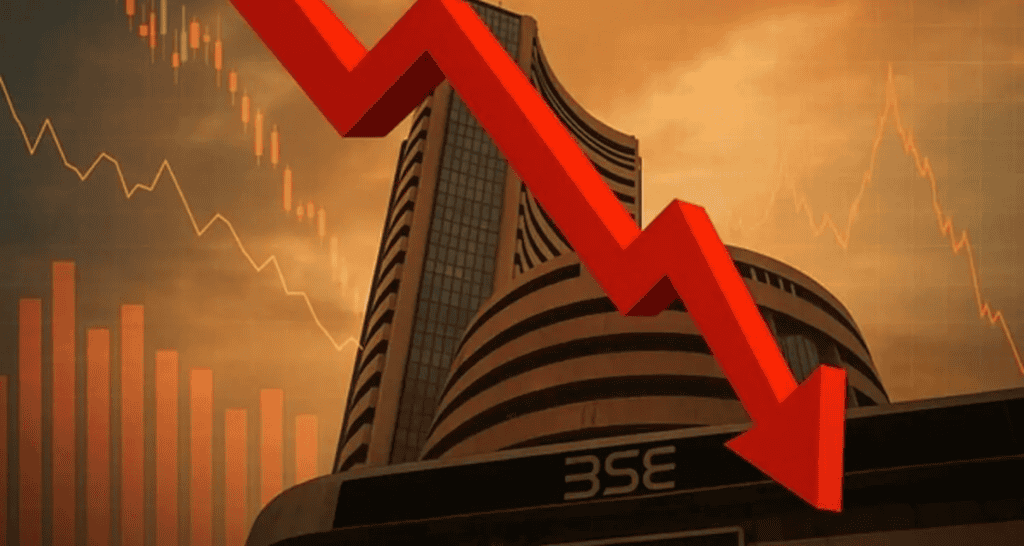
The Indian equity markets witnessed a sharp decline on Thursday, April 30, 2026, as global and domestic headwinds combined to pressure investor sentiment. Benchmark indices ended the session in the red, with the BSE Sensex falling 582.50 points (0.75%) to close at 76,913.50, while the NSE Nifty 50 slipped below the crucial 24,000 mark to settle at 23,997.55, down approximately 0.74%.
Market participants grappled with a combination of rising crude oil prices, continued foreign institutional investor (FII) outflows, and a strengthening U.S. monetary stance. Adding to the pressure was the Indian Rupee, which weakened to a record low of ₹95.1 against the U.S. dollar, intensifying concerns around imported inflation and macroeconomic stability.
Sectoral Pressure: Metals and Automobiles Lead Declines
The selling pressure was particularly evident in the metals and automobile sectors, both of which are sensitive to global demand cycles and input costs.
Hindalco Industries emerged among the top laggards, declining 3.2% amid volatility in global aluminum prices and concerns over weakening industrial demand. The metals pack remained under stress as investors factored in the possibility of slower global growth and reduced infrastructure spending.
In the automobile segment, Tata Motors Passenger Vehicles (TMPV) dropped 3.1%, reacting to muted sales expectations and caution around supply-chain disruptions. Ongoing geopolitical tensions, particularly involving the U.S. and Iran, have raised concerns about semiconductor availability and logistics bottlenecks—key risks for the auto sector.
Macro Headwinds: A Perfect Storm for Equities
The broader market weakness can be attributed to three major macroeconomic triggers that created a risk-off environment:
1. Crude Oil Rally
Brent crude prices surged towards the $120 per barrel mark following escalating geopolitical tensions and supply disruptions linked to U.S. actions against Iran. For India, a major oil importer, elevated crude prices translate into higher import bills, fiscal strain, and inflationary pressures.
2. Hawkish Federal Reserve Outlook
The U.S. Federal Reserve, led by Jerome Powell, maintained a firm stance on interest rates, signaling a “higher for longer” approach. With rates expected to remain in the 3.5%–3.75% range, global liquidity conditions are tightening. This reduces the attractiveness of emerging markets like India, leading to sustained FII outflows.
3. Domestic Political Uncertainty
Exit polls from key state elections introduced an additional layer of uncertainty. Political developments often influence short-term market sentiment, prompting traders to reduce exposure and adopt a cautious stance ahead of clearer outcomes.
Currency Weakness and FII Outflows Add Pressure
The sharp depreciation of the Indian Rupee further dampened sentiment. A weaker currency not only increases the cost of imports but also signals potential capital outflows. FIIs have remained net sellers, withdrawing funds amid global risk aversion and better yields in developed markets.
Technical Outlook: Critical Levels to Watch
From a technical perspective, the Nifty is approaching a decisive zone. The 23,950 level now acts as a crucial support threshold. A sustained breakdown below this level could accelerate selling pressure, potentially dragging the index toward 23,800 in the near term.
On the upside, immediate resistance is placed around 24,150. Any recovery toward this level may face selling pressure unless supported by positive global cues or easing geopolitical tensions.
Market Strategy: Caution Remains Key
Given the current volatility and uncertain macro environment, the near-term outlook remains cautious. The prevailing strategy among market participants is “sell on rise,” as broader sentiment continues to be fragile.
In such turbulent conditions, disciplined risk management and informed decision-making become critical. Traders and investors are advised to stay selective, focus on fundamentally strong stocks, and avoid aggressive positioning until clarity emerges on global developments.
Market Insights
- The ongoing surge in crude oil prices remains the biggest near-term risk for Indian equities, as it directly impacts inflation, currency stability, and corporate margins.
- Persistent FII outflows indicate global risk aversion, suggesting that emerging markets may continue to face pressure until clarity on U.S. interest rate policy emerges.
- Sector rotation is clearly visible, with defensive sectors likely to outperform while metals and autos may remain under pressure in the short term.
- Technically, the Nifty’s ability to hold the 23,950 support level will be crucial in determining the next directional move. A breakdown could trigger further downside momentum.
- Traders should adopt a cautious “sell on rise” strategy, while long-term investors may look for staggered buying opportunities in fundamentally strong stocks once volatility stabilizes.
- In such volatile conditions, insights from Eqwires can help traders make informed decisions through data-driven strategies, intraday calls, and expert market analysis.
Top-notch SEBI registered research analyst
Best SEBI registered Intraday tips provider
info@eqwires.com
Telegram | Facebook | Instagram
Call: +91 9624421555 / +91 9624461555