JLR reports 1.1% sales growth in Q4, achieves net debt zero in FY25

Tata Motors-owned Jaguar Land Rover (JLR) on Monday announced a 1.1 per cent year-on-year jump in wholesale dispatch at 111,413 units in fourth quarter of financial year 2025, and 6.7 per cent up as compared to Q3FY25. 

Compared to the preceding year, wholesale volumes for the fourth quarter were higher in North America (14.4 per cent), Europe (10.9 per cent) and flat in the UK (0.8 per cent), the company said in a statement. It was lower in China (29.4 per cent) and Overseas (-8.1 per cent). 

Meanwhile, the retail sales of the company stood at 108,232 units (including the Chery Jaguar Land Rover China JV) for Q4FY25, 5.1 per cent down compared to Q4 FY24 and up 1.8 per cent compared to Q3 FY25.

“The overall mix of the most profitable Range Rover, Range Rover Sport and Defender models was 66.3 per cent of total wholesale volumes in Q4 FY25 and 67.8 per cent for the full year,” the UK-based automaker said. 

Apart from giving out the sales numbers, the company also highlighted that it has achieved its net debt zero target, ending the financial year net cash positive. 

Paused shipments to the US

The announcement comes soon after JLR announced a temporary pause in the shipments to the US in response to the 25 per cent tariff on auto imports imposed by the Donald Trump administration. The halt caused a over 10 per cent crash in the stock price of Tata Motors in the Indian stock market.

“The USA is an important market for JLR’s luxury brands. As we work to address the new trading terms with our business partners, we are taking some short-term actions including a shipment pause in April, as we develop our mid- to longer-term plans,” JLR said in a statement on April 5.

Eqwires Research Analyst

Top-notch SEBI registered research analyst

Best SEBI registered Intraday tips provider

info@eqwires.com

Telegram Facebook Instagram

Call: +91 9624421555 / +91 9624461555

www.eqwires.com

Govt hikes excise duty on petrol, diesel by ₹2/ltr; retail prices unchanged

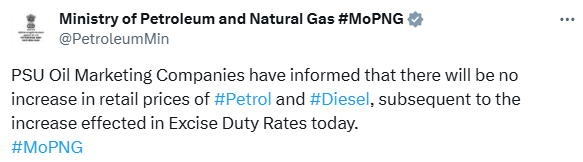
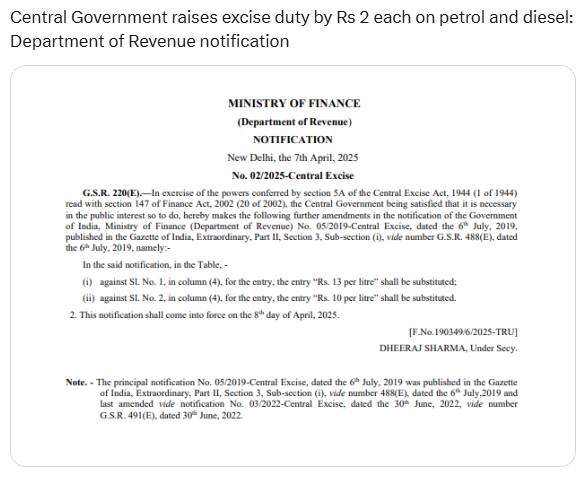
The Government of India, on Monday, raised excise duty on petrol and diesel by ₹2 per litre, according to an official notification by the Department of Revenue, Ministry of Finance. The order stated that the change will take effect from April 8. The excise duty on petrol was increased to Rs 13 per litre and that on diesel to Rs 10, according to the order.

While the excise duty has been increased, the Ministry of Petroleum and Natural Gas has confirmed that there will be no burden on the common man as there will be no increase in retail prices of petrol and diesel.

Earlier in December 2024, the government had scrapped the windfall profit tax on domestic crude and fuel exports, first imposed on July 1, 2022, amid falling global oil prices.

Eqwires Research Analyst

Top-notch SEBI registered research analyst

Best SEBI registered Intraday tips provider

info@eqwires.com

Telegram Facebook Instagram

Call: +91 9624421555 / +91 9624461555

www.eqwires.com

India market-cap drops ₹30 trn from March 2025 peak; check winners, losers

Bears on Dalal Street have pushed the market capitalisation (market-cap) of Indian companies to tumble nearly ₹30 trillion from their recent peak levels in March 2025. 

The benchmark indices — Nifty50 and 30-stock Sensex — posted a recovery of over 8 per cent since their lows hit in September 2024. From March 24, all this recovery was dented as US President Donald Trump’s tariff threats came into focus. Since the recent peak on March 24, the market cap of listed companies in India has plunged by ₹29.03 trillion, according to data from the BSE. 

In the Nifty 500 universe, Central Bank of India, KPIT Technologies, Anant Raj, National Aluminium (NALCO) and UCO Bank were among the top losers in terms of market-cap. Among big names, metal companies like Vedanta, Hindustan Copper and Hindalco Industries lost over 20 per cent in market-cap. Tata Motors and Tata Steel also lost nearly 20 per cent of their market-cap from March 24.

Only 40 companies in the Nifty 500 index saw their market increase in this period, and 13 among them were less than a 1 per cent rise. Tata Consumer Products, Aster DM Healthcare, BSE, and Vardhman Textiles saw their market-cap gain the most from March 24Tata Consumer’s market cap rose by 7 per cent while the other three company’s market cap advanced slightly by over 10 per cent.   

On Monday, the key gauges registered their biggest fall since June 4 last year as concerns over growth and fallout from US tariffs deepened the prevailing risk-off sentiment. After Trump hit China with a 54 per cent tariff to cripple exports to the US, Beijing retaliated with 34 per cent tariffs on all US imports.

Further, China restricted exports of seven types of rare earths, launched an anti-dumping probe into medical CT X-ray tubes from the US and India and imposed export controls on 16 US firms, among other measures. 

In addition to China, Canada announced 25 per cent retaliatory tariffs on some US-made vehicles while France’s Emmanuel Macron urged companies to pause US investments. All these add to global growth concerns, as pointed out by top brokerages. 

Analysts at BofA stay cautious on Indian equities as the tariffs act as an additional risk for markets. While the direct Impact of tariffs on India is limited, it could have a cascading impact, including potentially delayed capex decisions and impact credit growth, among others. “Given India’s rich valuations along with other concerns, we continue to stay cautious on Indian equities.”

India VIX surges 

During Monday’s session, India’s stock-market volatility gauge, India VIX, spiked 60 per cent as China’s retaliatory tariffs on US goods spooked traders. The spike in volatility came as the Sensex plunged 3,939 points in intraday trade to hit a low of 71,425.01, while the NSE Nifty50 breached the 21,800 mark to hit a low of 21,743. 

The last notable spike in the volatility index had occurred in August, when the unwinding of the Japanese yen carry trades had roiled Dalal Street along with global markets. Earlier, in June, the index had surged ahead of the Lok Sabha election results.

Eqwires Research Analyst

Top-notch SEBI registered research analyst

Best SEBI registered Intraday tips provider

info@eqwires.com

Telegram Facebook Instagram

Call: +91 9624421555 / +91 9624461555

www.eqwires.com

VBL, ICICI Bank: 5 stocks to buy and keep in your portfolio this April

Indian markets have been on edge over the last two sessions after US President Donald Trump’s reciprocal tariffs on over 180 countries, including India, rocked global markets. The US reciprocal tariff of 26 per cent on India is higher than expected, but is relatively lower than that levied on other Asian countries like China (34 per cent), Vietnam (46 per cent), Thailand (36 per cent), Indonesia (32 per cent) and Bangladesh (37 per cent) which compete with India for export share.

 While the Indian markets were visibly stable on Thursday, the sentiment took a beating on Friday after Donald Trump said he was planning tariffs on the pharma sector “like never before”. Consequently, the Nifty index tanked over 300 points to hit the day’s low of 22,921.60, whereas the Sensex index crashed 1,009 points intraday.

As analysts suggest investors to tweak their investment portfolios, focusing on domestic-economy lined stocks, Motilal Oswal Financial Services (MOFL) has listed out five stocks that investors could buy in April 2024. The brokerage has picked Varun Beverages, SRF, ICICI Bank, Indian Hotels, and Amber Enterprises as its focus ideas for the month. 

At 1:30 PM on Friday, April 4, Varun Beverages share was trading 1.61 per cent down at ₹535.25, SRF share price was down 1.11 per cent at ₹2,869.10, ICICI Bank up 0.49 per cent at ₹1,336, The Indian Hotels share was down 3.15 per cent at ₹804.85, and Amber Enterprises stock was down 4.20 per cent at ₹6,638.55. In comparison, the benchmark Nifty50 index was down 308.25 points or 1.33 per cent at 22,941.85. 

From a technical perspective, the immediate support for the Nifty index is at 23,150, followed by 23,000 zones, while resistance is at 23,400, followed by 23,550 zones. 

Eqwires Research Analyst

Top-notch SEBI registered research analyst

Best SEBI registered Intraday tips provider

info@eqwires.com

Telegram Facebook Instagram

Call: +91 9624421555 / +91 9624461555

www.eqwires.com
Trump speaks with India, Vietnam, Israel on trade deals ahead of deadline

President Donald Trump has spoken with representatives from India, Vietnam, and Israel to open talks on trade deals that may ease the impact of tariffs set to take effect next week, CNN reported on Saturday (IST). This outreach marks the first wave of diplomatic engagements since Trump announced blanket tariffs on more than 180 nations and reciprocal tariffs on Thursday. 

The reciprocal tariffs are scheduled to be enforced from 12:01 am ET on April 9 as part of Trump’s aggressive trade policy, which has imposed sweeping levies on 57 nations. While senior White House trade advisors Peter Navarro and Vice-President JD Vance have insisted that the measures signify a lasting realignment of global trade, other officials acknowledge Trump’s willingness to negotiate.

Mixed messages from Trump

Trump’s stance on the tariffs has been inconsistent. While he initially framed them as non-negotiable, he later hinted at possible compromises. Speaking aboard Air Force One, he claimed that multiple nations had reached out seeking deals, portraying the tariffs as a strategic tool for securing favourable agreements. 

“As long as they are offering something beneficial, we are open to discussion,” he said. “Look at TikTok as an example. China may want us to reconsider the tariffs in exchange for approving a deal. The tariffs give us significant leverage.”

“I wouldn’t want to be the last country to try to negotiate with Donald Trump,” the president’s son, Eric Trump, posted on X. “The first to negotiate will win—the last will absolutely lose. I have seen this movie my entire life.” 

However, the president also sent mixed signals, stating in a social media post on Saturday (IST), “Big business is not worried about the tariffs because they know they are here to stay. But they are focused on the BIG, BEAUTIFUL DEAL, which will SUPERCHARGE our economy. Very important. Going on right now!!!” 

Despite backlash from corporate America, global trading partners, and even some members of Congress, Trump has shown no indication of backing down from his tariff strategy. His administration insists that these measures are essential to reshaping international trade relations in favour of the United States.

Shifting tariff rates and confusion

India was initially subjected to a 27 per cent tariff, later revised to 26 per cent. This was not an isolated case as 17 other countries also saw their tariff rates altered by exactly one percentage point. Confusions stemmed from discrepancies between Trump’s announcement on April 2 and the initial order which noted different figures – leading the administration to align the order with the president’s original statement. 

Vietnam has been hit particularly hard, facing a 46 per cent duty on its exports to the US. Meanwhile, Israel, despite having preemptively eliminated all tariffs on American imports in a bid to avoid retaliation, was still subjected to a 17 per cent levy.

India is actively engaged in trade negotiations with the US in hopes of mitigating the impact of the tariffs. Exporters are optimistic that ongoing bilateral talks could yield concessions that might ease the burden on Indian industries. 

Global response, trade war

The tariffs have triggered widespread repercussions. Global markets tumbled for a second consecutive day after China announced retaliatory measures, including a 34 per cent duty on American goods effective from April 10. Beijing also declared its intent to file a complaint with the World Trade Organization and suspend exports of rare earth materials. 

The European Union, subjected to a 20 per cent tariff, has pledged a measured and unified response, while Japan, which faces a 24 per cent duty, has urged restraint.

South Korea’s acting president has called for dialogue, while Bangladesh plans to formally appeal to the United States Trade Representative.

Eqwires Research Analyst

Top-notch SEBI registered research analyst

Best SEBI registered Intraday tips provider

info@eqwires.com

Telegram Facebook Instagram

Call: +91 9624421555 / +91 9624461555

www.eqwires.com