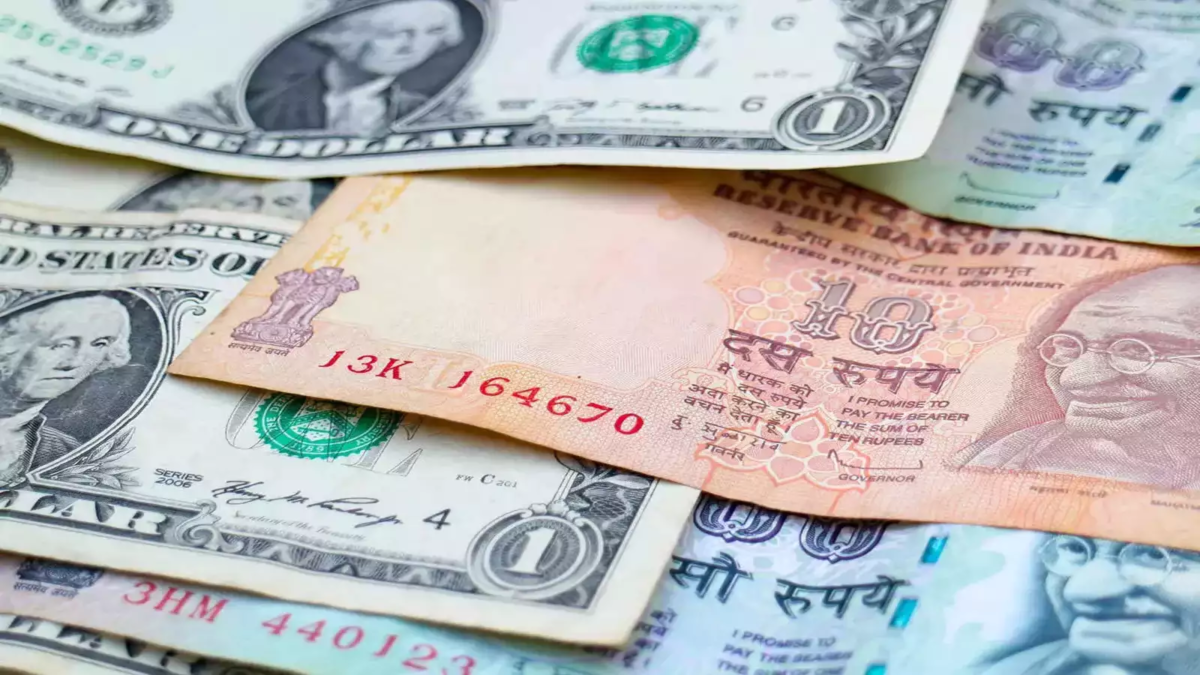
Rupee tumbles 9 paise to close at fresh record low of 85.20 against US dollar

The rupee extended the slide for the second straight session and depreciated 9 paise to settle at a fresh all-time low of 85.20 (provisional) against the US dollar on Tuesday, dragged by a strong greenback against major crosses overseas and subdued domestic equities.

According to analysts, increased demand of dollar due to month-end payment obligation and the fear of an aggressive import tariff by the Donald Trump administration in the US strengthened the greenback.

Besides, surging crude oil prices pushed the rupee down further, they added.

At the interbank foreign exchange, the rupee opened at 85.10 and touched the lowest ever level of 85.21 against the greenback during intra-day. The unit finally ended the session at a fresh all-time low of 85.20 (provisional) against the dollar, registering a loss of 9 paise from its previous close.

On Monday, the rupee settled 7 paise lower at 85.11 against the US dollar.

Meanwhile, the dollar index, which gauges the greenback’s strength against a basket of six currencies, was trading higher by 0.11% at 107.93, amid soaring US Treasury yields and the fear of delayed interest rate cuts by the US Federal Reserve.

Brent crude, the global oil benchmark, rose 0.69% to $73.13 per barrel in futures trade.

In the domestic equity market, the 30-share BSE Sensex closed lower by 67.30 points, or 0.09%, at 78,472.87 points, while Nifty fell 25.80 points, or 0.11% to close at 23,727.65 points.

Foreign Institutional Investors (FIIs) were net sellers in the capital markets on Monday, as they offloaded shares worth ₹168.71 crore, according to exchange data.

Eqwires Research Analyst

Top-notch SEBI registered research analyst

Best SEBI registered Intraday tips provider

info@eqwires.com

Telegram Facebook Instagram

Call: +91 9624421555 / +91 9624461555

www.eqwires.com

RBI report sees economic recovery in Q3; FPI flows turns positive in Dec

India’s gross domestic product (GDP) growth, which plunged to 5.4 per cent in the July–September quarter, is making a comeback in the October–December period, according to high-frequency indicators cited in the State of the Economy report by the Reserve Bank of India (RBI). “High-frequency indicators (HFIs) for the third quarter of 2024–25 indicate that the Indian economy is recovering from the slowdown in momentum witnessed in Q2, driven by strong festival activity and a sustained upswing in rural demand,” the report, authored by RBI staff, including Deputy Governor Michael Patra, said. 

The views expressed in the report are those of the authors and not the RBI.

The report said India’s growth trajectory is poised to lift in thesecond half of 2024-25, driven mainly by resilient domestic private consumption demand.  

“Supported by record-level foodgrain production, rural demand, in particular, is gaining momentum. Sustained government spending on infrastructure is expected to further stimulate economic activity and investment,” it said. 

GDP growth is estimated at 6.8 per cent in Q3 and 6.5 per cent in Q4 of the current financial year. The RBI, in the December review of monetary policy, lowered the FY24 growth projection to 6.8 per cent from 7.2 per cent.

Global headwinds, however, pose risks to the evolving outlook for growth and inflation, the report noted.

“The time to act is now to excoriate inflation and revive investment strongly, especially as the usual winter easing of food prices is setting in and the prospects of private consumption and exports accelerating are getting brighter,” it said. Additionally, the prospects for agriculture and, hence, rural consumption are “certainly looking up” with a large part of the kharif harvest likely to be reflected in the GDP estimates for the third quarter.

Based on the economic activity index, which indicates a pick-up in momentum in November on a seasonally adjusted basis, the nowcast for Q3 GDP growth in 2024–25 is placed at 6.8 per cent.

“High-frequency indicators suggest that aggregate demand continued to expand in October/November 2024. E-way bills increased by 16.3 per cent (year-on-year) in volume terms in November. Toll collections recorded double-digit growth in November 2024, both in value and volume terms,” the report said. 

Noting that headline inflation grew at a slower pace in November (5.5 per cent) compared to October (6.2 per cent), the report said high-frequency food price data for December (as of December 19) showed a fall in rice prices, though wheat and atta prices continued to rise. 

“Edible oil prices, too, continued exhibiting upside pressures. Pulses prices, however, registered a broad-based decline. Among key vegetables, onion and tomato prices fell, while potato prices remained range-bound,” it said.

The report also noted that foreign portfolio flows to domestic debt instruments turned positive in December 2024 after outflows in October and November. 

Net FPI outflows stood at $2.4 billion in November 2024, with net equity outflows of $2.7 billion and net debt inflows of $0.3 billion. 

“However, FPI flows turned positive during December (as of December 18) with net inflows of $3.6 billion,” the report said. 

Within sectors, oil, gas, and consumable fuels, and automobile and auto components recorded the highest equity outflows, while information technology and financial services received the largest inflows during November.

“Rising global economic and financial uncertainties during November resulted in equity outflows from other EMEs as well,” it added.

Eqwires Research Analyst

Top-notch SEBI registered research analyst

Best SEBI registered Intraday tips provider

info@eqwires.com

Telegram Facebook Instagram

Call: +91 9624421555 / +91 9624461555

www.eqwires.com
BSE, NSE to remain closed on these days in New Year 2025

Market participants—especially those who can’t get enough of their busy hours on Dalal Street—are set to have an eventful 2025 with fewer holidays during the year compared to 2024. This is because days like Republic Day will be during the weekend in the New Year in contrast to 2024 when they were during weekdays. The year 2024 also had more holidays on account of general and assembly elections. 

On the other hand, 2025 will have two holidays that were not there the previous year: Mahavir Jayanti and Dr Baba Saheb Ambedkar Jayanti. This is because these days occurred during the weekend in 2024.  

Market Holiday List 2025: Here is a complete list of market holidays in the New Year 2025:  

HolidayDateDay
MahashivratriFebruary 26, 2025Wednesday
HoliMarch 14, 2025Friday
Id-Ul-Fitr (Ramzan Id)March 31, 2025Monday
Shri Mahavir JayantiApril 10, 2025Thursday
Dr.Baba Saheb Ambedkar JayantiApril 14, 2025Monday
Good FridayApril 18, 2025Friday
Maharashtra DayMay 01, 2025Thursday
Independence DayAugust 15, 2025Friday
Ganesh ChaturthiAugust 27, 2025Wednesday
Mahatma Gandhi Jayanti/DussehraOctober 02, 2025Thursday
Diwali BalipratipadaOctober 22, 2025Wednesday
Prakash Gurpurb Sri Guru Nanak DevNovember 05, 2025Wednesday
ChristmasDecember 25, 2025Thursday

So there will be 13 market holidays in 2025 (in addition to the weekly offs). Additionally, a special ‘Muhurat’ trading session will be held on October 21 in 2025. This marks a special session—typically one hour long—to mark the onset of a New Year as per the Vikrami calendar. 

Eqwires Research Analyst

Top-notch SEBI registered research analyst

Best SEBI registered Intraday tips provider

info@eqwires.com

Telegram Facebook Instagram

Call: +91 9624421555 / +91 9624461555

www.eqwires.com
Rs 17 Lakh Crore Added To Mutual Funds In 2024, Is This The Biggest Boom Ever?

After a stellar 2023, the mutual fund industry sustained its growth momentum in 2024 with an impressive Rs 17 lakh crore surge in assets, driven by buoyant equity markets, robust economic growth, and increasing investor participation. Experts are predicting the positive trend will extend into 2025.

The year 2024 saw a substantial net inflow of Rs 9.14 lakh crore, alongside a significant 5.6 crore increase in investor count and a growing popularity of SIPs, which alone contributed Rs 2.4 lakh crore, according to data from the Association of Mutual Fund Industry (Amfi), as reported by news agency PTI in an analysis.

Continued Growth Expectations for 2025

Kaustubh Belapurkar, Director-Manager Research at Morningstar Investment Research India, said, “The mutual fund industry’s assets are expected to continue growing at a healthy pace in 2025. With rising penetration among retail investors, flows into equity funds, particularly through Systematic Investment Plans (SIPs), are likely to remain robust.”

AUM Reaches All-Time High

The inflows lifted the industry’s assets under management (AUM), reaching an all-time high of Rs 68 lakh crore by November-end, marking a 33 per cent growth over the Rs 50.78 lakh crore registered at the end of 2023.

Comparison with Previous Growth Trends

This growth was way higher than 27 per cent rise and Rs 11 lakh crore addition in AUM in 2023, as well as the more modest growth in previous years.

The industry saw a 7 per cent growth and Rs 2.65 lakh crore increase in AUM in 2022, as well as nearly 22 per cent growth and close to Rs 7 lakh crore addition to the asset base in 2021.

Consistent Upward Trajectory

Over the last four years, the industry has collectively added an impressive Rs 30 lakh crore to its AUM.

Year-on-Year AUM Growth

As per the data, the AUM of the mutual fund industry rose to an all-time high of Rs 68 lakh crore in 2024 (till November-end) from Rs 50.78 lakh crore at the end of December 2023. This year’s tally does not include December number which will come out in the first week of 2025.

The asset base stood at around Rs 40 lakh crore at the end of December 2022, Rs 37.72 lakh crore at the end of December 2021 and Rs 31 lakh crore in December 2020.

The 12th Consecutive Year of Growth

The 2024 also marked the 12th consecutive yearly rise in the industry AUM after a drop in two preceding years. This year growth in the industry was supported by inflows in equity schemes, especially Systematic Investment Plans (SIPs).

Over the last four years, the mutual fund industry has collectively added an impressive Rs 30 lakh crore to its AUM, showing the sector’s consistent upward trajectory.

“The growing trend of financialisation has led to a significant growth in participation in equity markets and mutual funds, as reflected in the significant growth of AUM in the mutual fund industry,” said Ganesh Mohan, CEO of Bajaj Finserv AMC.

“This shift is supported by the Indian economy’s expansion and increasing financial awareness among retail investors, who are seeking higher returns at lower costs and with greater convenience,” he added.

Equity Schemes Drive Growth

The 45-player industry saw a total inflow of Rs 9.14 lakh crore in 2024 (till November) as compared to an inflow of over Rs 2.74 lakh crore last year. The huge inflow could be on the back of sustained investor interest in equity funds, arbitrage funds, and index funds & ETFs.

This year’s flows included an investment of Rs 3.53 lakh crore in equity-oriented schemes, Rs 1.44 lakh crore in hybrid schemes, and around Rs 2.88 lakh crore in debt schemes.

Equity Market Contributions and SIPs

Equity schemes, which were the most attractive factor for investors in the mutual fund space in 2024, schemes have been witnessing incessant net inflow on a monthly basis since March 2021.

The contribution of equity markets has also been key, with the Nifty 50 and BSE Sensex indices rising 8.5 per cent and 8 per cent, respectively, in 2024.

SIP Contributions Surge

The net inflows into equity-oriented schemes stood at Rs 3.53 lakh crore, driven by sustained investor confidence and the structural shift toward long-term, disciplined investing through SIPs.

Monthly SIP contributions consistently surpassed the Rs 25,000-crore mark in October and November, signalling their growing appeal.

Investment Trends and Thematic Funds

“Investment through SIP into equity funds has become the default nature of investing for predominant Indian investors on back of structural shift in savings pattern, and equity markets continuing on the decadal growth trajectory is an established trend in India,” Akhil Chaturvedi, ED & CBO, Motilal Oswal AMC, said.

Growth in Sectoral and Thematic Funds

Notably, sectoral and thematic funds emerged as major attractions, with their AUM growing 79 per cent to Rs 4.61 lakh crore in 2024 from Rs 2.58 lakh crore in December 2023. These funds benefited from heightened retail interest, supported by Rs 1.4 lakh crore in inflows, including Rs 67,000 crore raised through 40 new fund offerings (NFOs), Morningstar’s Belapurkar said.

Debt Funds and Institutional Investors

On the debt side, categories like liquid, ultra-short, and low-duration funds saw robust inflows, driven primarily by institutional investors seeking short-term liquidity. Meanwhile, retail investors showed renewed interest in gilt and dynamic duration funds, anticipating potential rate cuts in early 2025.

Gold Investment Trends

Gold investments also gained traction, with inflows of Rs 9,500 crore as investors sought safety amid economic uncertainties, geopolitical tensions, and changes in taxation norms.

Gold’s Role in Portfolio Diversification

Aashish Somaiyaa, CEO of WhiteOak Capital AMC, noted that gold’s appeal as a portfolio hedge has been further boosted by its integration into multi-asset allocation funds.

“At the same time given there has been uncertainty of US monetary policy, time to time USD weakness and geopolitical fault lines being exposed, gold is always a safe haven to have in client portfolios,” he added.

Taxation Changes on Gold ETFs

Starting April 2025, Gold ETFs will be taxed as per investor’s tax slab for a holding period of less than 1 year and at 12.5 per cent for a holding period of more than 1 year, bringing them on par with taxation for equity, Vishal Jain, CEO, Zerodha Fund House, said.

Regulatory Support for Growth

Adding to the industry’s vibrancy, the regulatory environment played a key role.

Sebi has introduced measures to boost mutual fund penetration and oversight. The MF Lite framework simplifies setting up asset management companies, encouraging new players in passive funds. The new ‘Specified Investment Funds’ asset class enables boutique products to reach more investors with a reduced minimum ticket size of Rs 10 lakh, compared to Rs 50 lakh for PMS and Rs 1 crore for AIFs.

Eqwires Research Analyst

Top-notch SEBI registered research analyst

Best SEBI registered Intraday tips provider

info@eqwires.com

Telegram Facebook Instagram

Call: +91 9624421555 / +91 9624461555

www.eqwires.com

Govt-owned oil refiners struggle to get adequate crude supplies from Russia

India’s state oil refiners are finding it hard to buy the volume of Russian crude they need, according to people familiar with the matter. 

Oil executives from three of the nation’s government-owned processors said they haven’t been able to obtain enough Russian crude for January loading in the so-called spot market. The people, who have direct knowledge of their companies’ purchases, declined to be identified as they’re not authorized to speak publicly. 

Executives from state refiners, including Indian Oil Corp., Bharat Petroleum Corp. and Hindustan Petroleum Corp., said they were unable to procure at least six million barrels of Urals crude they had sought from the spot market. It was unclear why there were fewer offers, although factors such as a long-term contract between Rosneft PJSC and Indian private refiner Reliance Industries Ltd., and higher Russian processing rates may have led to lower crude exports, they added.   

Separately, the people also said it could be Moscow’s way of reducing spot cargoes sold by traders in favour of long-term contracts done directly with Russian producers. Indian state refiners currently buy all their Russian crude through the spot market, while private firms do so via a combination of spot and long-term contracts. 

Officials from the state-owned companies said there were alternative cargoes in the market from the Middle East and Africa, although supplies were pricier and would erode margins. Government refiners have bought about 1 million barrels a day of Russian crude so far this year, according to Kpler data. That’s drastically up from close to no imports before the Ukraine war. 

Moscow has been pressing Indian firms to lock in their imports via long-term contracts, which are usually done between Russia’s state-run firms such as Rosneft PJSC and Gazprom Neft PJSC, and Asian buyers, according to the executives. While New Delhi is also in favor of that, urging all state and private refiners such as Reliance to jointly negotiate for better terms, some government-linked processors haven’t been able to accept the offer price and terms, they said.  

In early December, Reuters reported that Reliance had proceeded to independently secure a 500,000 barrels-a-day deal with Rosneft for 10 years, a move that state companies say has weakened the country’s overall bargaining power. They added the deal has likely emboldened Russia to sell less in the spot market via traders, explaining the lack of spot cargoes.  

Indian Oil, BPCL and HPCL didn’t immediately reply emails seeking comments on the issue. Indian Oil previously had a term contract with Russia for 490,000 barrels a day for the fiscal year ended March. 

Eqwires Research Analyst

Top-notch SEBI registered research analyst

Best SEBI registered Intraday tips provider

info@eqwires.com

Telegram Facebook Instagram

Call: +91 9624421555 / +91 9624461555

www.eqwires.com