
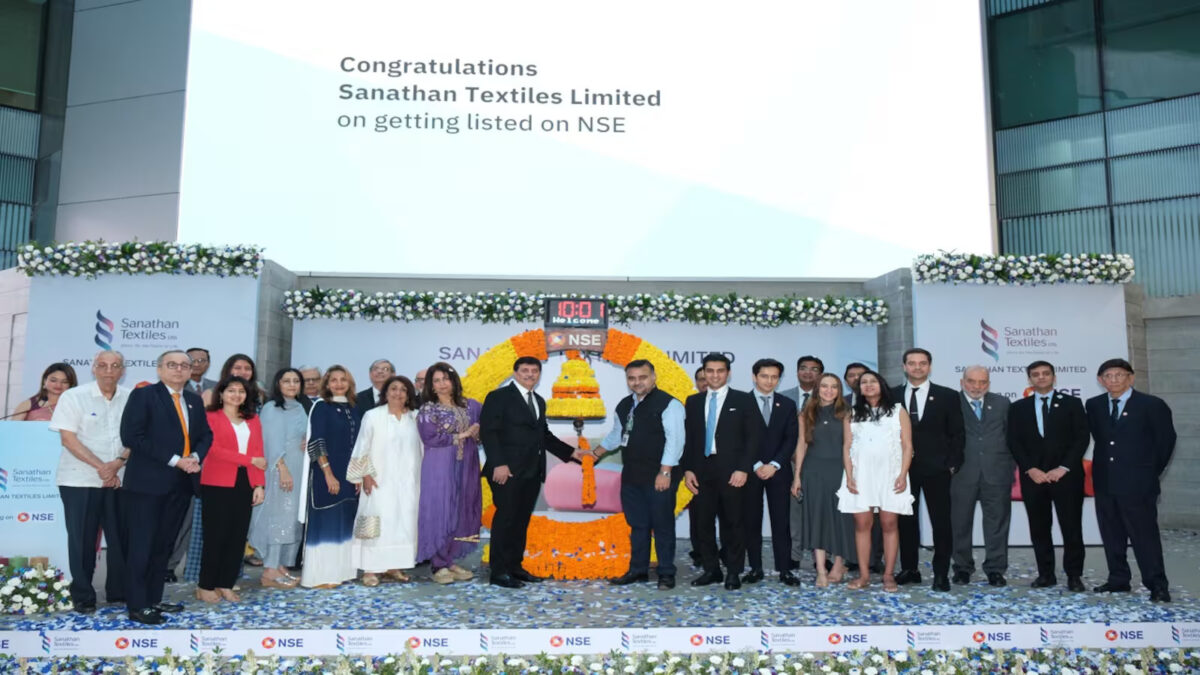
Sanathan Textiles shares list at ₹422, a 31% premium compared to its IPO price

Shares of Sanathan Textiles Ltd. listed on the stock exchanges at ₹422 per share, a 31% premium compared to its IPO price of ₹319 on Friday, December 27.

The Sanathan Textiles IPO saw healthy subscription of 36.9 times the total shares on offer. The three-day issue received bids worth over ₹14,000 crore, compared to the initial plan of raising ₹550 crore.

Sanathan Textiles’ IPO was a combination of a fresh issue of shares worth ₹400 crore and an Offer for Sale (OFS) component of ₹150 crore.

Sanathan Textiles intends to use ₹160 crore out of the ₹400 crore proceeds to repay its existing dues in part or full, while ₹140 crore will be used to invest in its subsidiary, Sanathan Polycot Pvt. Ltd. The other ₹100 crore will be used for general corporate purposes.

The Sanathan Textiles IPO was open between December 19 and 24. The allotment for the IPO was finalised on December 24 after the three-day issue received healthy subscription.

The Sanathan Textiles IPO was subscribed 35.05 times, led by qualified institutional buyers (QIBs). Overall, investors placed bets for 44.26 crore shares, compared to the 1.26 crore shares that were on offer for them.

The portion for institutional investors was subscribed 75.62 times, while that for non-institutional investors was subscribed 42.18 times.

Retail investors too placed bids that were 8.84 times higher than the shares reserved for them in the IPO.

The manufacturing company has three business verticals — polyester yarn products, cotton yarn products and yarns for technical textiles and industrial uses. It sells its products to a diverse customer base, including both multinational and local companies.

For the first quarter of this fiscal, the company reported a revenue of ₹781 crore, with a profit after tax of ₹50 crore. Its earnings before interest, taxes, depreciation and amortisation (EBITDA) came in at 76.4 crore, with a margin of 9.7%.

In FY24, the company reported a revenue of 2,957 crore, with a PAT of ₹134 crore, EBITDA of 226.5 crore and margin of 7.6%. Whereas, in FY23, it reported a revenue of ₹3,329 crore, PAT of 152.7 crore, EBITDA of 259.5 crore and margin of 7.8%.

The polyester yarn product contributed 76.8% to its first quarter in FY25 revenue, while the cotton yarn products and industrial and technical textiles yarns contributed 18.7% and 4.4%, respectively.

Eqwires Research Analyst

Top-notch SEBI registered research analyst

Best SEBI registered Intraday tips provider

info@eqwires.com

Telegram Facebook Instagram

Call: +91 9624421555 / +91 9624461555

www.eqwires.com

Indian banks’ profitability improves for six straight years, NPAs decline to 13-year low: RBI report

The profitability of banks improved for the sixth consecutive year in 2023-24 and their gross bad debts or non-performing assets (NPAs) declined to a 13-year low of 2.7 per cent. According to a report released by the Reserve Bank of India (RBI) on Thursday, December 26, the financial position of Indian banks has stayed robust, marked by the sustained expansion in loans and deposits.

India’s macro fundamentals have boosted the performance and soundness of the banking and non-banking financial sectors. “Banks’ profitability rose for the sixth consecutive year in 2023-24 and continued to rise in H1:2024-25 with the return on assets (RoA) at 1.4 per cent and return on equity (RoE) at 14.6 per cent,” said RBI in its Report on Trend and Progress of Banking in India 2023-24.

RBI outlines performance of banks, NBFCs

Asset quality improved, with the gross non-performing assets (GNPA) ratio falling to its lowest in 13 years at 2.7 per cent at end-March 2024 and 2.5 per cent at end-September 2024. RBI said the capital position of banks remained satisfactory, as reflected in key parameters like leverage ratio and capital to risk weighted assets ratio (CRAR).

The net bad loans of banks fell to 0.57 per cent of total loans at September-end, from 0.62 per cent at end-March, driven by stronger loan-loss buffers. The asset quality of non-bank finance companies (NBFCs) also improved further in 2023-24 amid a sustained double-digit balance sheet growth, said the central bank.

Further, strong credit expansion by NBFCs was accompanied by further strengthening of their balance sheets, improvement in credit quality and profitability, and satisfactory capital buffers. The net profit of the scheduled commercial banks increased by 32.8 per cent to ₹3,49,603 crore during the last fiscal.

At end-March 2024, India’s commercial banking sector consisted of 12 public sector banks (PSBs), 21 private sector banks (PVBs), 45 foreign banks (FBs), 12 SFBs, six PBs, 43 RRBs, and two LABs. Out of these 141 commercial banks, 137 were classified as scheduled banks, while four were non-scheduled.

The RBI report said the consolidated balance sheet of the scheduled commercial banks, excluding RRBs, increased by 15.5 per cent during 2023-24, as compared with 12.2 per cent during 2022-23. The non-banking financial companies (NBFC) sector exhibited double digit credit growth, while its unsecured lending contracted and asset quality improved further. The GNPA ratio of NBFCs dropped to 3.4 per cent at end-September 2024; strong capital buffers kept the CRAR well above the stipulated norm at end-September 2024.

Outlook for banks, NBFCs

Over the past year, the RBI has warned the financial sector against “all forms of exuberance”, tightened rules for credit card and personal loans, made it more expensive for NBFCs to borrow from banks and imposed regulatory restrictions on the non-compliant lenders and financial institutions that serve customers.

Banks have also cleaned up their balance sheets in recent years by selling bad loans to asset reconstruction companies or by writing them off. Their capital and liquidity buffers stayed well above the regulatory needs while profitability improved for the sixth consecutive year in fiscal year 2023-24, said the RBI report.

Going forward, banks need to strengthen risk management and IT governance standards, and focus on checking unscrupulous activities, including suspicious and unusual transactions, said RBI. For NBFCs, an imprudent ‘growth at any cost’ approach would be counterproductive, the RBI said, highlighting the need for robust risk management frameworks. Non-bank lenders need to strengthen customer grievance practices and avoid recourse to usurious interest rates, it said.

Eqwires Research Analyst

Top-notch SEBI registered research analyst

Best SEBI registered Intraday tips provider

info@eqwires.com

Telegram Facebook Instagram

Call: +91 9624421555 / +91 9624461555
www.eqwires.com

Indian economy to grow at around 6.5% in FY25, government says

 India’s economy is expected to grow at around 6.5% in fiscal year 2024/25, closer to the lower end of its 6.5%-7% projection, as global uncertainties pose a dampening threat, the government said on Thursday.

The growth outlook for October to December appears bright, with rural demand remaining resilient and urban demand picking up in the first two months of the quarter, according to the finance ministry’s monthly economic report for November.

Growth slowed more than expected in July to September, hampered by weaker expansion in manufacturing and consumption. India has maintained that its economy will grow at a world-beating pace of 6.5%-7% despite a challenging environment.

The outlook is expected to be better in October-to-March than in the first six months of the financial year, it said.

“The combination of monetary policy stance and macroprudential measures by the central bank may have contributed to the demand slowdown,” the report said.

India’s central bank has kept interest rates unchanged for 11 straight policy meetings, despite calls for rate cuts to support growth amid high inflation.

For the next financial year starting April 1, 2026, the report said, newer risks have emerged, such as uncertain global trade growth and a stronger U.S. dollar.

U.S. President-elect Donald Trump has threatened many nations, including India, with higher tariffs on imports, raising risks of a global trade war after he takes office on Jan. 20. Trump’s election victory has also fuelled a run-up in the dollar and U.S. yields.

However, India’s growth outlook in 2025/26 and coming years is bright in terms of domestic economic fundamentals, the finance ministry’s report said.

Eqwires Research Analyst

Top-notch SEBI registered research analyst

Best SEBI registered Intraday tips provider

info@eqwires.com

Telegram Facebook Instagram

Call: +91 9624421555 / +91 9624461555

www.eqwires.com